
Parker Lake Trail In Early Summer: Wildflowers & Plants Through a Nature Nerd's Eyes
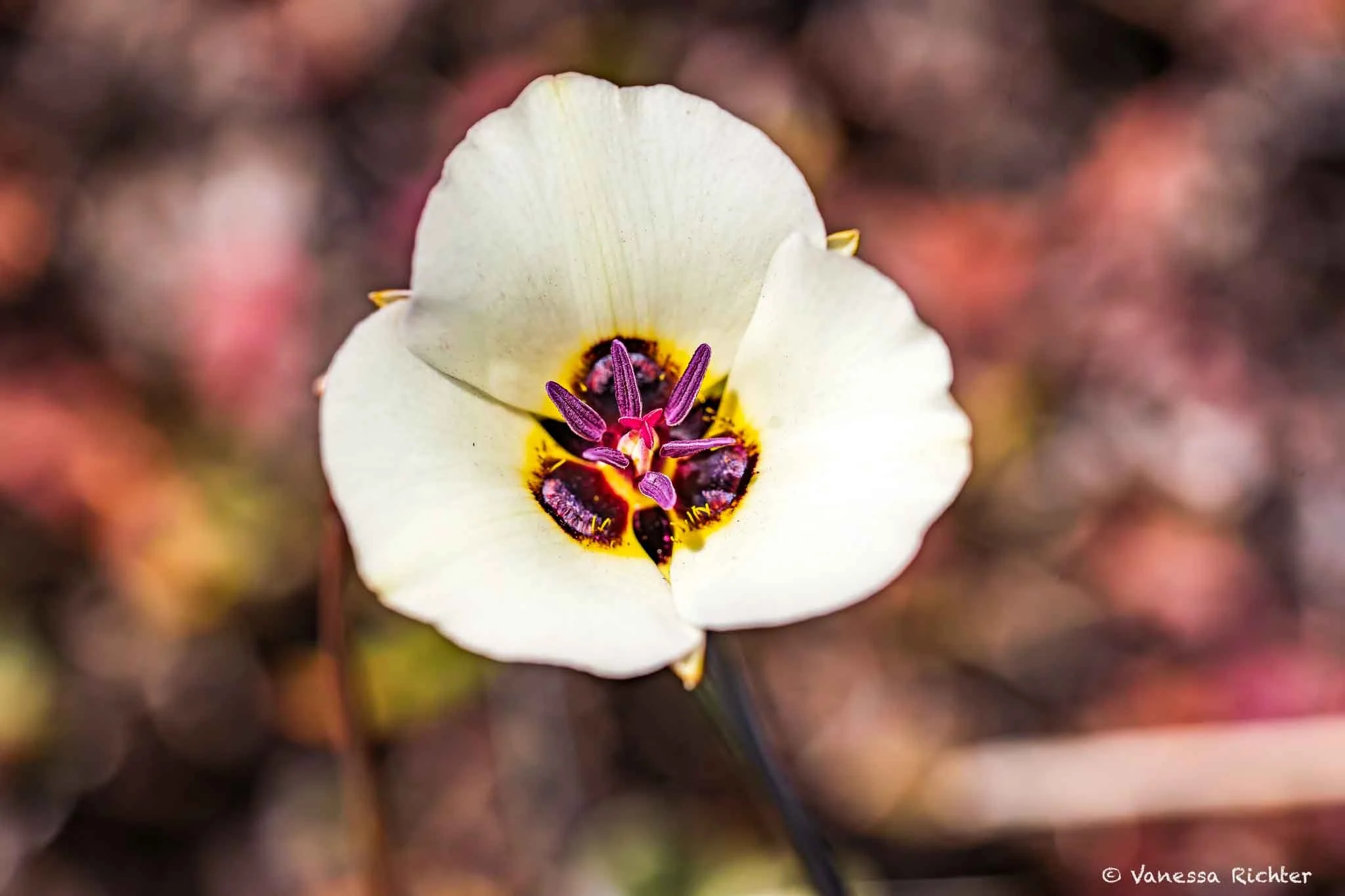
A Pinyon Mariposa Lily hiding in the desert scrub of the Parker Lake Trail — one of the quiet surprises waiting for those who look closely enough.
This post contains affiliate links. If you book through them, I may earn a small kickback at no extra cost to you, which helps me write free resources like this one — thank you for supporting my blog.
The Parker Lake Trail sits in the Ansel Adams Wilderness of Inyo National Forest, deep in the Eastern Sierra Nevada — and it might be the best effort-to-reward ratio of any mountain hike in the range. The destination is a glacially carved lake with water so clear it carries a faint turquoise tint, framed by a panorama of rugged Sierra peaks. That view alone is worth the trip.
But if you slow down and look closely, there's a whole other hike happening alongside the scenic one. Early summer is when the Eastern Sierra feels most alive: wildflowers pushing through dry scrub, freshly fledged birds wandering the meadows, bees moving between blooms, and streams running full with snowmelt.
In this article I'll share what I found hiking to Parker Lake at the start of July — the ecological details hiding right in front of you that turn a short hike into something closer to a nature treasure hunt.
📋 In This Article
Hiking Parker Lake: Between Desert, Wildflowers, And Mountain Lakes

Scan for map & details
📏
3.6 mi
5.8 km
Distance
⛰
649 ft
198 m
Elevation
🔙
Out & Back
Route
Our car was rhythmically vibrating under the tiny stones that covered the road and rubbed our tires leading up to the trailhead. The moist scent of a desert morning was all present and flowing into the open window. Sage brushes swayed lightly in the soft breeze as we passed them.
My mind drifted to the day before: the Sierra Nevada mountain range through the Tioga Road and Yosemite National Park with its High Alpine Forests and the typical granite geology. As the landscape flew by to our sides, slowly, the trees became scarcer, the earth turned browner and sage brushes, neatly keeping an approximately equidistant distance to each other, emerged. It was the fourth of July weekend, so Yosemite was packed with visitors. But much fewer had chosen to stay on the Eastern side of the mountain range, so finding a spot to camp on public land wasn't too difficult. Jeffrey Pines that thrive in this dry habitat surrounded us on a clear and chilly night, which we spent with a glimpse of Mono Lake in the distance.
The vibration suddenly stopped.
I realized I had hit the brakes on autopilot as something emerged on the road. Brown and fluffy on scraggly, tiny legs, they made their way along the street, unclear what to do with that metallic colossus in their way. The fluff balls turned out to be baby grouse and their mum, sooty grouse most likely, and they seemed to have gone on one of their first adventures in their lives together this morning. They went back and forth, seemingly undecided, or maybe some of their first rebellious moves to show their mom that they have their own ideas. Once the chickens and mum had decided that the side of the road was fine for now, we continued and reached the trailhead shortly after.
From Sagebrush Seas To Mountain Lakes
The trail begins in the high desert scrub of the Mono Basin in the rain shadow of the Sierra Nevada. As little as fifteen inches of rain a year makes it over to the eastern side of the mountain range, where desert and alpine ecosystems blend into each other, with every step making the change happen a little more. As we walked the first steps onto the trail, layers of distinct ecosystems spread out before us: a sea of sagebrushes transitioned into conifers, and mountain walls lacking any vegetation from a distance.
While trees hadn't made it to the dry ground of the lower elevations of this hike, the sagebrushes lining the beginning of the trail stood together densely, dispersing their aroma all around on this damp morning. That resinous scent, so pleasant to our senses, is actually a chemical defense, a volatile oil that makes the plant less palatable to herbivores (aka animals that feed on plants).
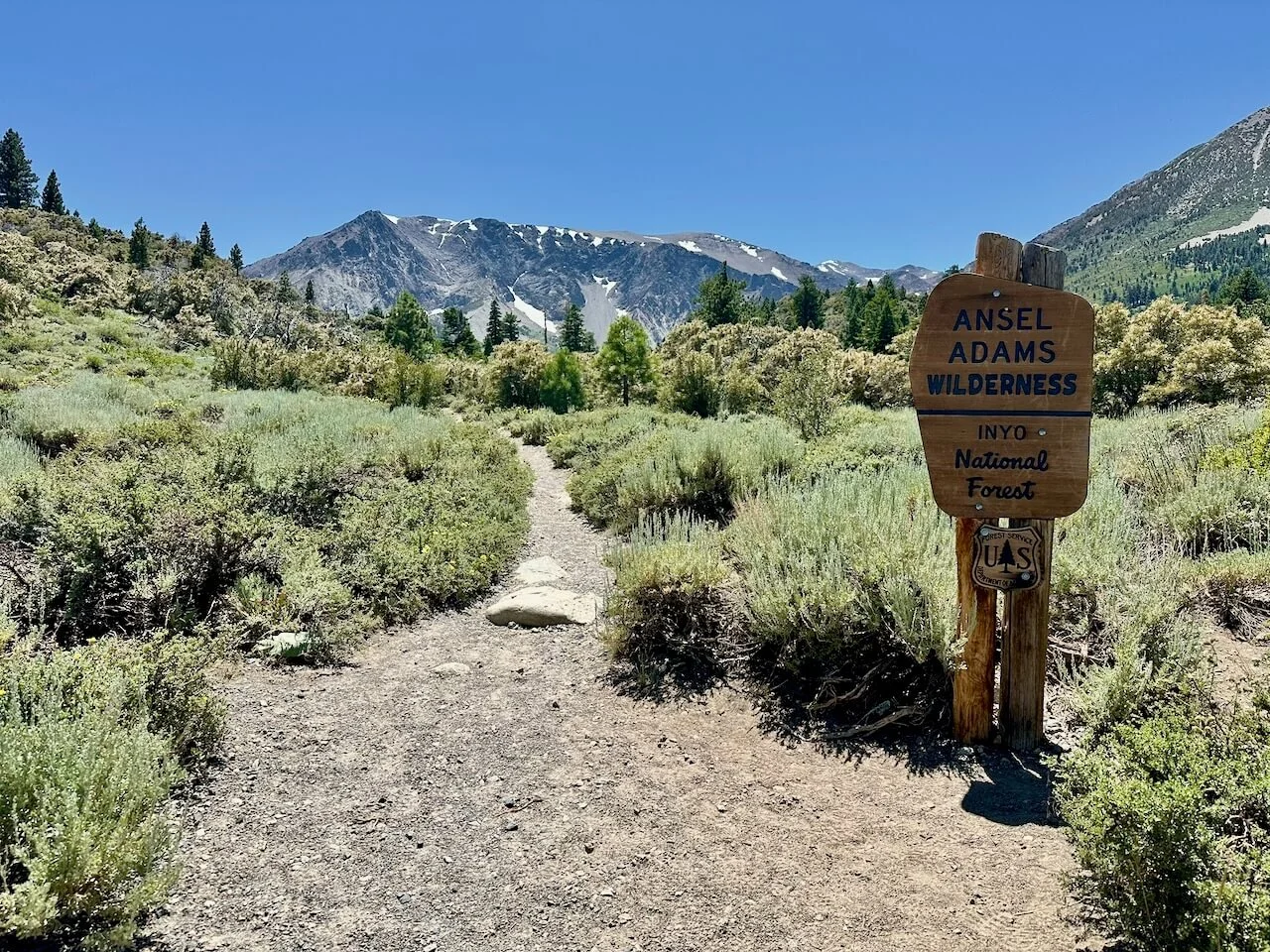
Parker Lake Trailhead in the Ansel Adam Wilderness, with the Eastern Sierra Nevada rising behind the sagebrush scrub of the Mono Basin.
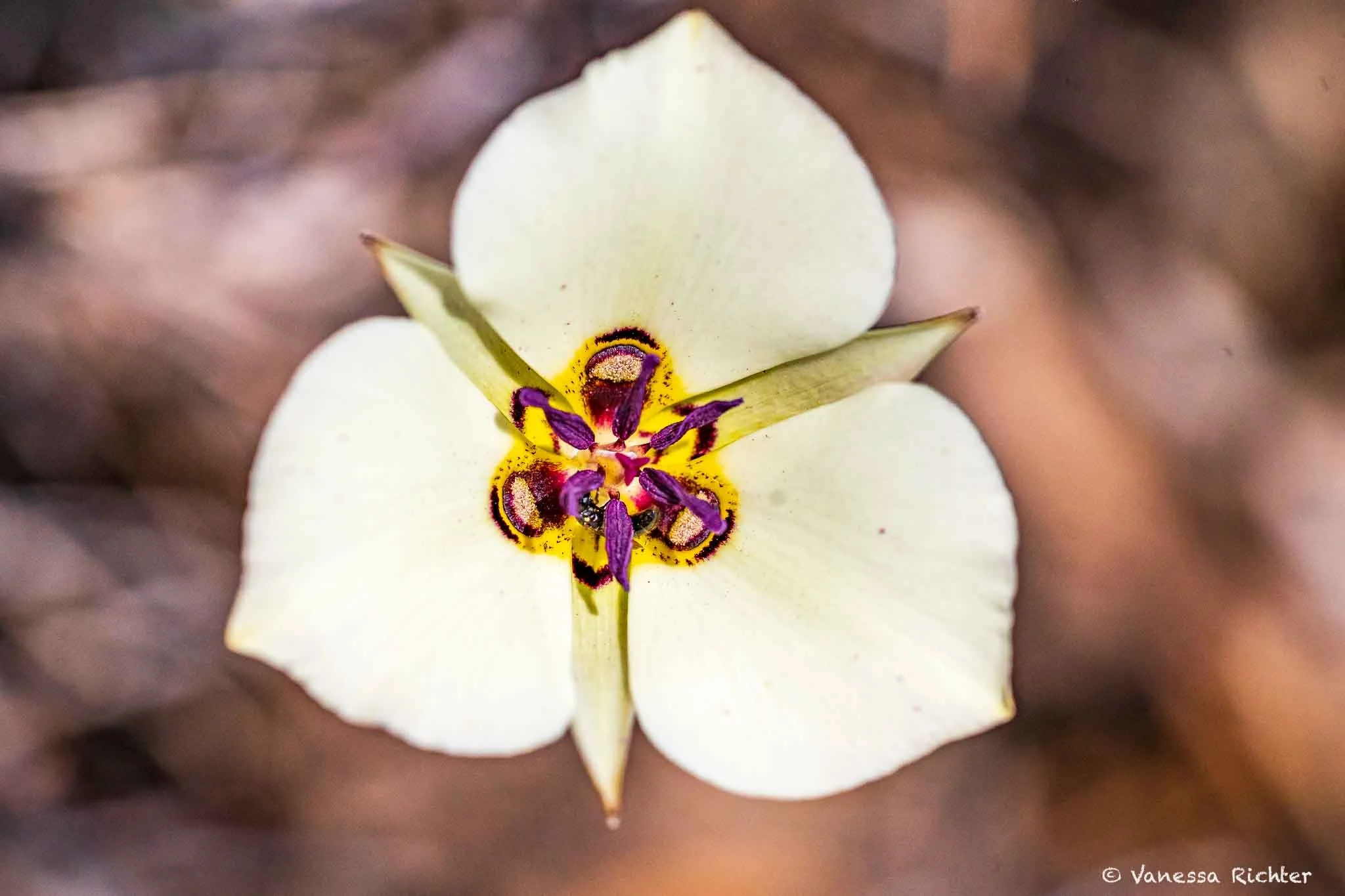
Right from the start, it was not only the scent that caught our attention, but the colors sprinkled across the sage, the humming in the midst of the lightly swaying leaves and the vibe of buzzing business. Wildflowers were showing off in all shapes and sizes. Most visually apparent from a distance, Sulfur Buckwheat seemed like it wanted to make a statement with its striking yellow color in all the pastel green. In the midst of the thick scrub, there was something more inconspicuous at first sight: a small white flower seemed to grow within it, scraggly grayish branches and small leaves with their thick waxy layer weaving below it. "Oh, those bushes have flowers?" was my first thought until a closer look revealed the truth: this small flower had made its way from the dry ground several feet up through the hardy desert scrub into the light. Insects seemed to appreciate it, working busily in search for nectar. What the petals lacked in color, the inside made up for: deep purple anthers surrounded the pink stamen backdropped by a warm yellow and a pattern of more purple and black accents. The Pinyon Mariposa Lily turned out to be a quiet poser.
🌸 Wildflower Spotlight: Pinyon Mariposa Lily (Calochortus bruneaunis)
☀️ Built for dry places. The Pinyon Mariposa Lily (Calochortus bruneaunis) is at home in Parker Lake's sagebrush scrub — adapted to dry, brushy, low-water conditions.
🎨 Plain on the outside, vivid within. What looks like a simple white flower from a distance reveals an interior of pink, purple, and yellow at the petal base — coloration that functions as a nectar guide, directing pollinators to exactly the right spot.
🗺️ A wide ranger. This species spans from eastern California to Montana, always in dry, open sagebrush habitats. The Eastern Sierra population sits at the southwestern edge of that range.
🌱 Survivor by design. Like all Mariposa Lilies, it grows from a deep starchy corm that survives drought, frost, and fire — sending up a fresh stem each season from the same underground base.
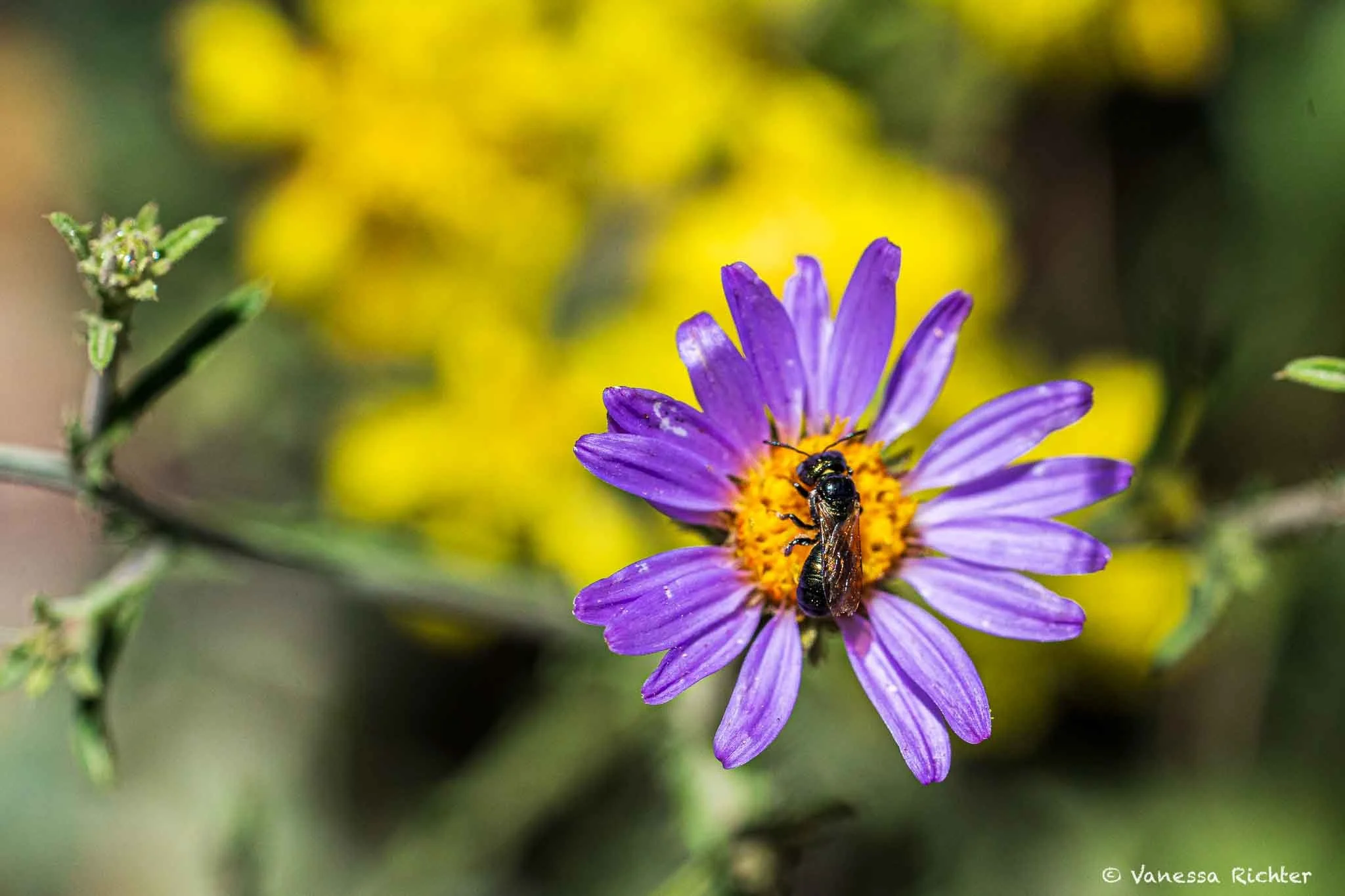
Scattered through the same dry scrub, look for the purple-rayed blooms of hoary tansyaster (Dieteria canescens) — lavender-to-purple daisy-like flowers with yellow centers, branching freely on stems that can reach knee height by mid-summer. Touch the stems and you'll notice they're sticky and faintly scented, a glandular texture that probably deters small crawling insects from climbing up and stealing nectar without pollinating. What makes this plant worth stopping for is the activity around it: in early July, hoary tansyaster is another busy intersection for native bees, small butterflies, and hoverflies.
The Tree You Smell Before You See It
Higher on the trail and getting closer to Parker Lake, the sagebrush gives way to open forest and the first Jeffrey pines appear. They look, at a glance, almost identical to Ponderosa pine — and they can hybridize too, which can make them difficult to tell apart. However, there's a distinct feature that reveals the Jeffrey pine: press your nose into the furrows of the bark and inhale. Jeffrey pine smells unmistakably of vanilla or butterscotch. It's not subtle. The Jeffrey Pine basically smells like a bakery. The scent comes from the tree's resin chemistry. Ponderosa pine can produce a similar scent in other parts of its range, but in California it's often scentless, making the smell test a reliable trick on the eastern Sierra.
💡 Know Your Pines
🌲 Jeffrey pine (Pinus jeffreyi) is the dominant large pine of the eastern Sierra Nevada above ~6,000 ft. The ponderosa pine is the closest look-alike (and they hybridize too). Not sure which pine you're looking at? Here's a quick cheat sheet:
| 🍪 Jeffrey | 👃 Ponderosa | 💧 Lodgepole | |
|---|---|---|---|
| Needles | 3 per bundle | 3 per bundle | 2 per bundle |
| Bark smell | Reliably vanilla / butterscotch | Often scentless in CA; can smell vanilla elsewhere | Faint / neutral |
| Cone | Large (5–12 in), gentle inward prickles | Medium (3–6 in), sharp outward prickles | Small (1–2 in), egg-sized, smooth |
| On this trail | Open forest | Unlikely | Near creek & aspens |
💡 Memory trick: "Gentle Jeffrey, Prickly Ponderosa"
Quaking Aspens, Clonal Groves & Nature’s Architects
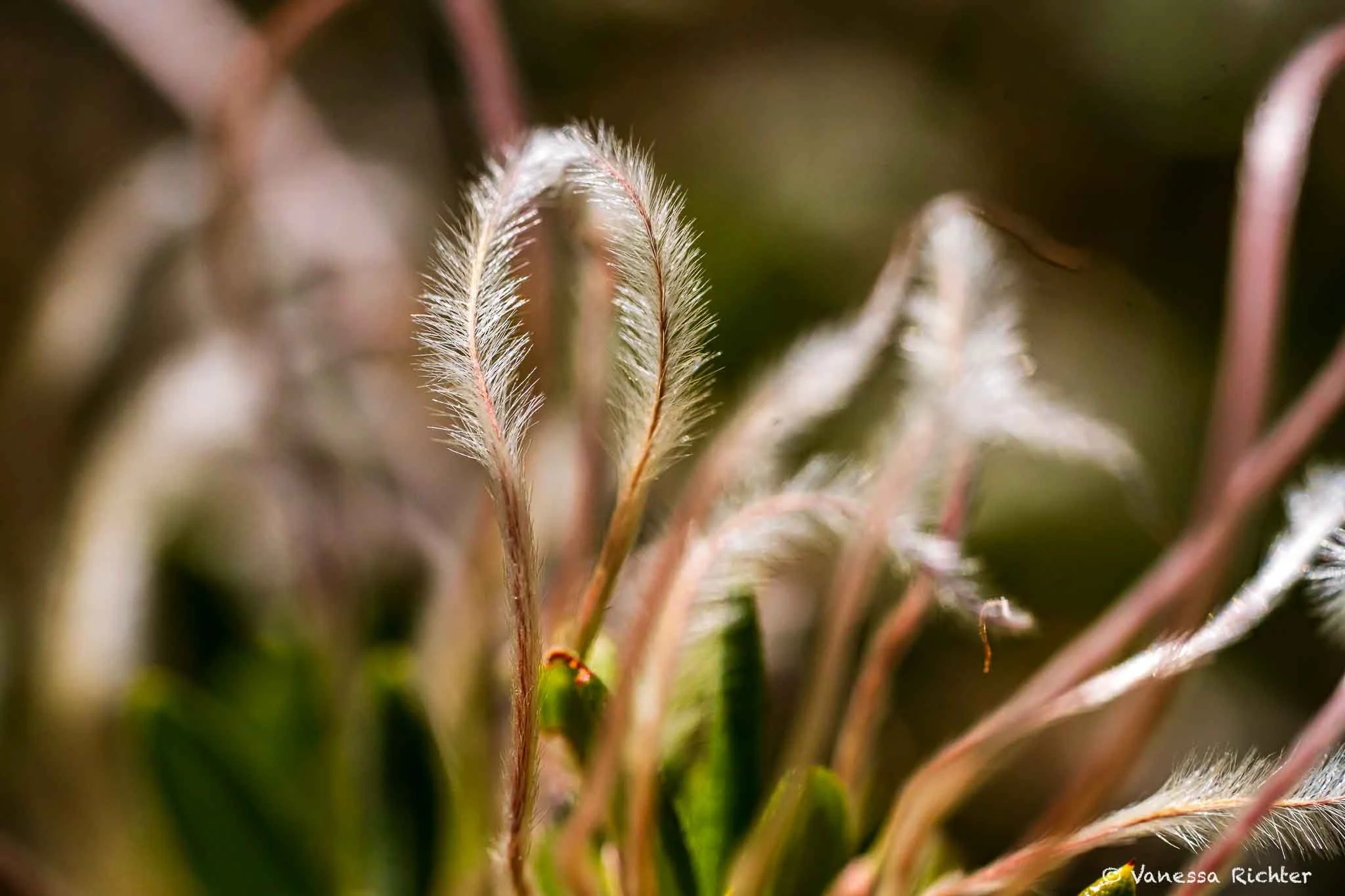
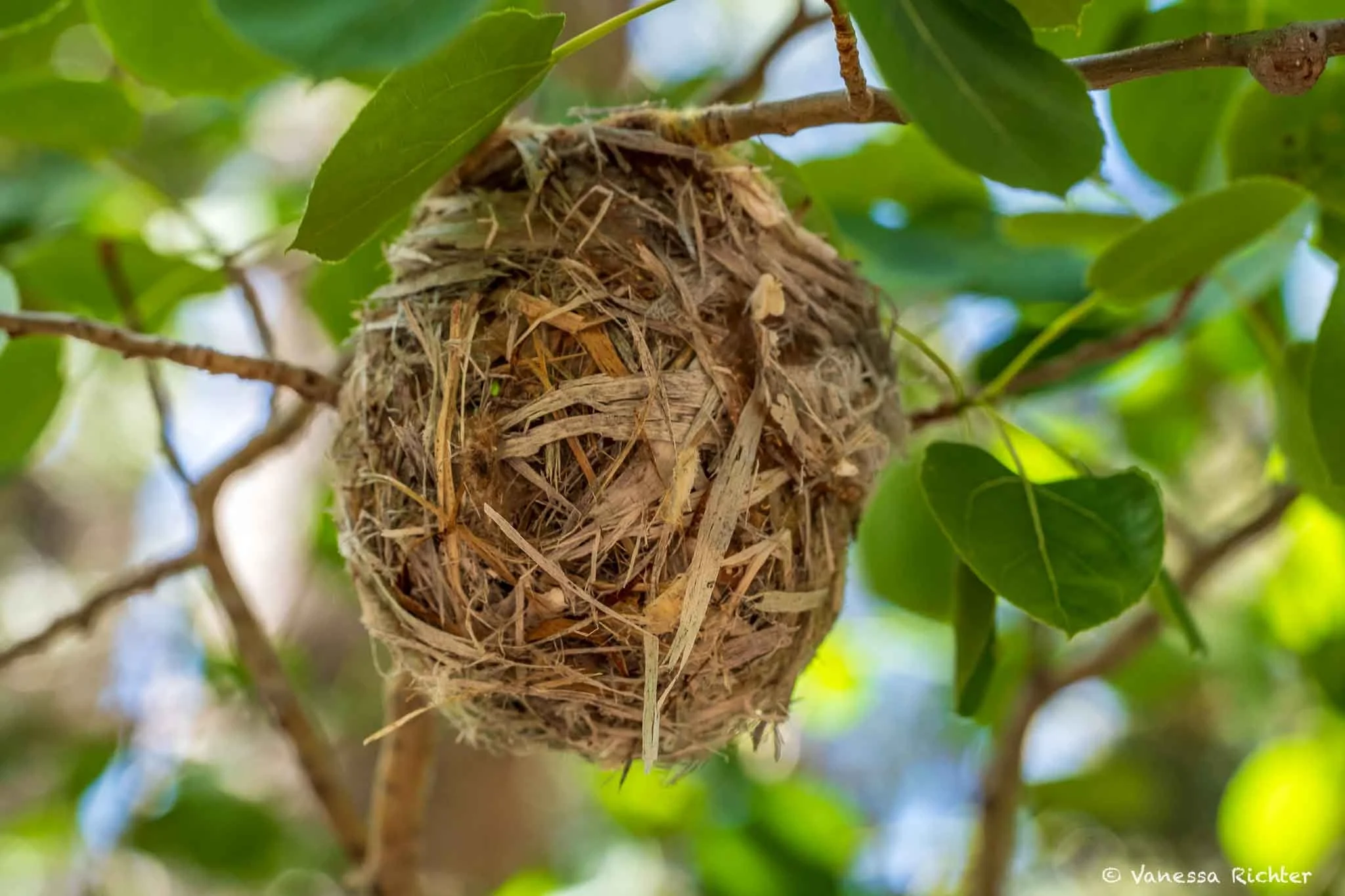
The trail follows Parker Creek, and at one point we found a nice access point to the water's edge where we filled up our filter bottle with cold, fresh water and paused for a moment longer. Here, the scenery was much different from the dry desert scrub at the beginning of the trail. Quaking aspens line the water's edge of the creek, their leaves trembling in the lightest breeze, looking like they're shivering. Just looking at the shaking leaves made me pull on my sweater again while we observed the rushing water splashing and polishing the stones, taking leaves and twigs on its way down the mountain. While we sat there, we spotted something else in an aspen tree. It was made of fibrous, dried plant material, perfectly woven together into a round shape, mounted with precision just enough on a branch. It must have been a bird's nest, its inhabitant already fledged.
💡 Did You Know?
🍃 Aspen leaves flutter constantly — even in the faintest breeze — because their leaf stalks are flat rather than round. The reason? The constant movement lets sunlight reach deeper into the tree, so even the lower leaves can photosynthesize.
🗣️ So distinctive it made it into language. The aspen's flutter inspired idioms in multiple languages — German, my mother tongue, keeps the original image alive with zittern wie Espenlaub ("tremble like aspen leaves"). English got there too with "shake like a leaf," though the aspen has since been lost from the phrase.
🌳 One grove, one organism. Many aspen groves share a single root system. Utah's famous Pando has ~47,000 trunks and is estimated to be thousands of years old. Whether the aspens along Parker Lake Trail are one organism or many isn't known — no genetic testing has been done according to my research.
🍂 How to guess without a lab? In autumn, trunks sharing a root system turn gold at the same time and in the same shade — so if one patch goes gold while its neighbor stays green, they're likely separate organisms.
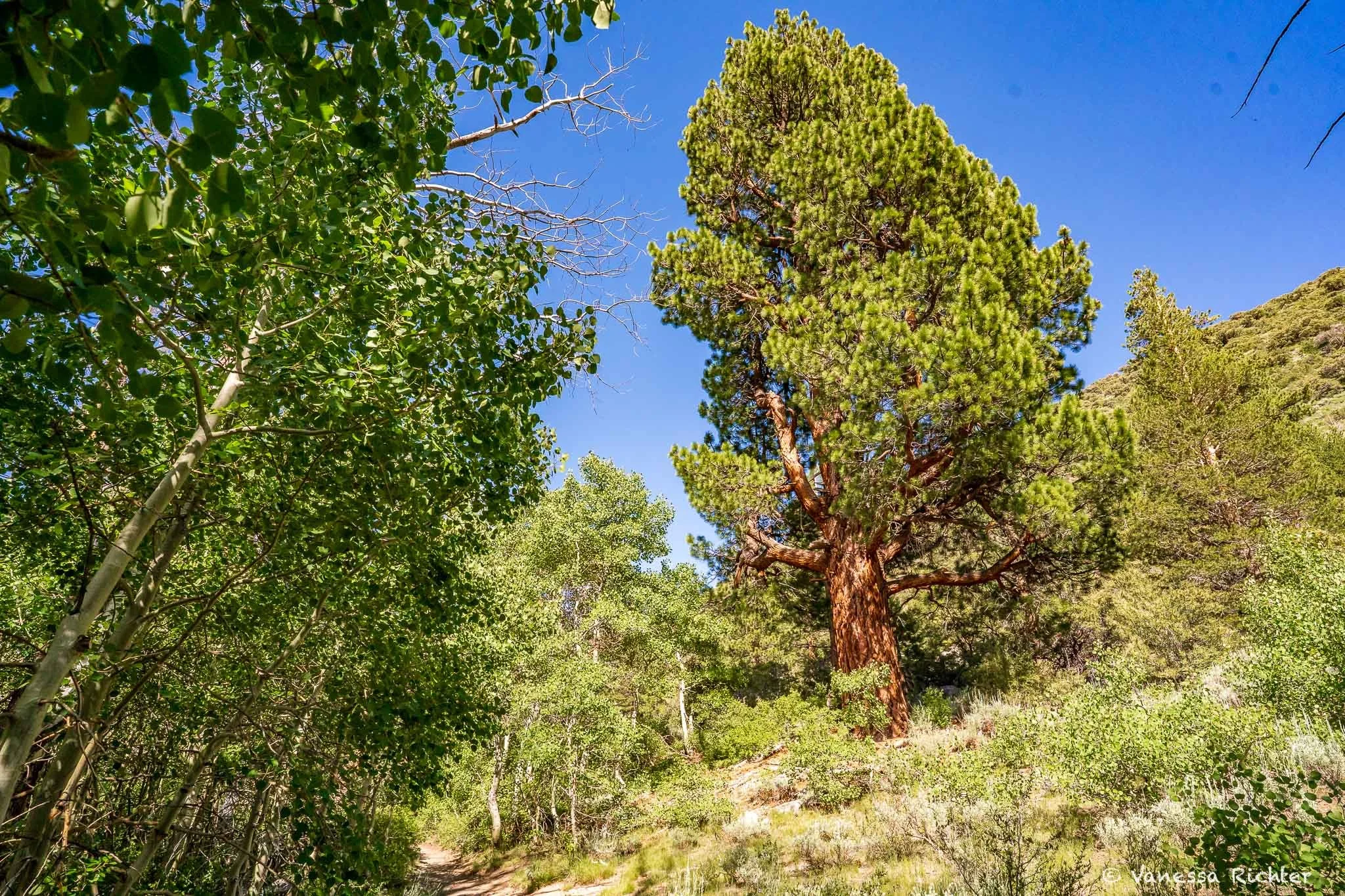
Where Jeffrey pine meets quaking aspen: the trail passes through two distinct ecosystems, each shaped by their relationship with water. The aspens follow Parker Creek; the Jeffrey pine thrives in the drier ground above.
After marveling at all the small things along the way, we finally arrived at Parker Lake. The trail had been generous with its details, but now it was showing off its arguably most prominent feature to discover: faint turquoise water, a Sierra Nevada panorama closing in on all sides, green meadows and dark-green conifers pointing up from the lakeshore. The Jeffrey pine-scented breeze just lightly stirred the surface, making the scene feel alive and calm at the same time. We went around the lakeshore slowly, and the lake kept offering something different at every corner: here a fallen log half-submerged at the water's edge, there just the open water and the peaks reflected in it. It kept revealing itself differently with every few steps — a different frame, a different mood, a different story if we just care enough to keep looking and asking questions.
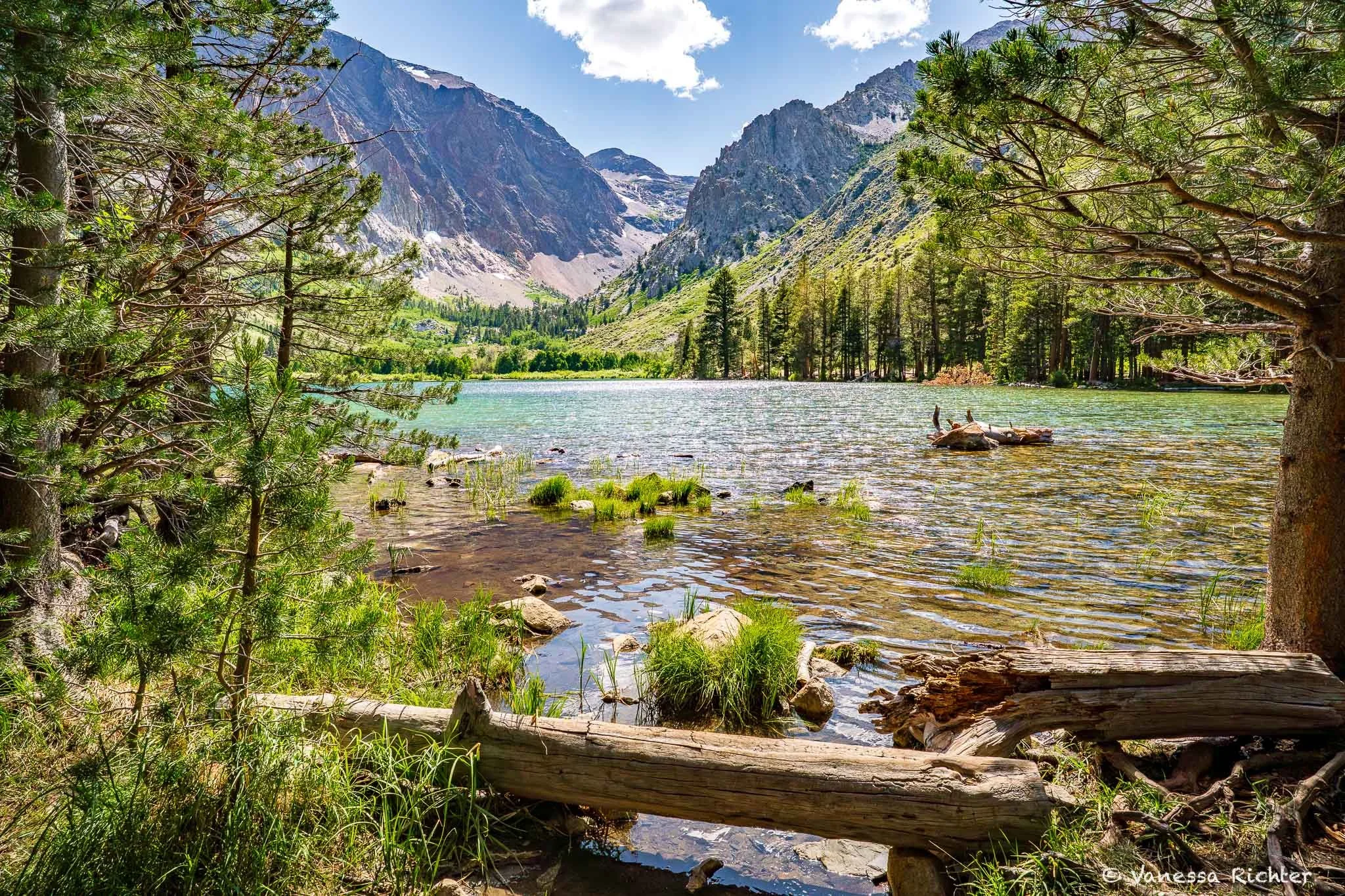
Parker Lake opens up at the end of the trail, faint turquoise and lightly stirred by the breeze, the mountains closing in on all sides.
🌿 The Naturalist's Kit
Turn a hike into a treasure hunt — the closer you can look, the more you know, the more there is to find.
Everything listed here is gear I personally use and recommend. The links below are Amazon affiliate links, which means if you find a recommendation helpful and buy through my link, I receive a small commission at no extra cost to you. This is what makes free resources like this possible. If you liked my article and something here ends up in your pack, using my link is the best way to say thanks — it costs you nothing and keeps this kind of content going.
📖 Sierra Nevada Field Guide
John Muir Laws' illustrated guide is THE ONE to carry. The drawings are not only stunning, but actually helpful in identifying what you see. It covers plants, insects, birds, mammals, and geology in a compact format — without adding significant weight to your pack.
🔭 Ultra-Compact Binoculars
My absolute essential on literally every hike. My go-to choice is super compact and lightweight — I don't even waste a thought about whether to bring them. I always do (if I don't forget them, because I am a headless zombie sometimes).
🔎 Loupe
Super small and easy to forget — until you're kneeling next to a Pinyon Mariposa or a lichen-covered rock and it becomes the most useful piece of gear. Plants (and rocks) have so many details that are incredibly hard to see with the naked eye. The loupe I have is really cheap, but I haven't found any reasons to upgrade yet.
📸 Lightweight Full Frame + Macro Lens
The setup that made the Pinyon Mariposa photo possible. One of the most compact full-frame bodies available, keeping weight low with full frame image quality. The macro lens reveals what the naked eye misses — all the details on flower petals, bee wings, fine hairs on plant stems. The price for what I've linked below is certainly more of an investment, but very reasonable for what you get. However, if you're just starting out with photography, I'd recommend getting a camera with a crop sensor first (which are MUCH more inexpensive and still deliver much better quality than a phone).
📱 Free Apps Worth Having
iNaturalist — spot something you can't identify? Upload a photo and the app's AI takes a first guess, then the community confirms or corrects it. It's become one of my most-used tools on the trail.
Merlin Bird ID — made by the Cornell Lab of Ornithology, Merlin can identify birds just by listening to their song in real time.
In case you're interested in my full hiking gear setup, I've linked it here.
Know Before You Go
Access
From the West (San Francisco via Tioga Road)
- Take Highway 120 (Tioga Road) through Yosemite, exit onto US-395 North toward Lee Vining, then turn onto Highway 158 (June Lake Loop) and follow Parker Lake Road to the trailhead.
- Tioga Road is seasonal — it typically closes around November and reopens in late May or June depending on snowpack. Check current status at nps.gov before you go.
From US-395 (North or South)
- Turn onto Highway 158 (June Lake Loop), then onto Parker Lake Road (dirt road) to the trailhead.
- Arrive early — the parking lot is small and fills up fast (see AllTrail link below for trailhead location).
Best Time to Visit
- Summer (June–August): Vegetation is at its lushest and wildflowers are in bloom.
- Fall (mid-September–mid-October): Peak aspen color in the Eastern Sierra. Timing shifts year to year depending on temperatures.
- Late Fall–Spring: Both Parker Lake Road and Tioga Road are typically closed due to snow. Check conditions before you go.
Useful Resources
- AllTrails — trail map, current conditions, and recent hiker reviews.
- iNaturalist — spot something you can't identify? Upload a photo and the app's AI will take a first guess, followed by the community to confirm or correct it.
- Leave No Trace — not sure how to handle waste disposal in the backcountry or what the principles actually mean in practice? This is the place to look.
Leave No Trace
- No permanent restrooms at the trailhead or at the lake. Porta-potties are sometimes available, but don't count on it.
- Dogs are welcome on leash.
- Stay on trail. Take pictures, take memories — leave the wildflowers where they belong.
- Pack out everything you bring in. No bins at the trailhead.
Read On

Follow the Adventure
Latest on the Blog
Looking For Something?

Mono Lake is one of the oldest lakes in North America — likely more than 760,000 years old and possibly over a million years old. For all that time, Eastern Sierra streams have been pouring in, carrying salts and minerals down from the mountains. With no outlet for roughly the past 80,000 years, water can only leave through evaporation, and the salts stay behind. A handful of species have evolved to thrive in exactly these conditions, and they do it in staggering numbers. I'll share how to best explore this special lake, plus all the details about its existence and the life it supports that make it so fascinating beyond its beauty.