
When the fog has lifted its summer blanket, the storms in the Pacific emerge, and migratory birds from as far north as Alaska arrive in California, we get to experience the most stunning spectacles along the coast. In winter, the seagulls, ravens and the threatened snowy plovers at San Francisco’s Ocean Beach are joined by flocks of bubbly sanderlings that have traveled thousands of miles from the Arctic to finally reach the California coast, and the occasional marbled godwit from the northern prairies. With Ocean Beach’s crashing waves as the backdrop, the wide-open beach becomes a place that feels like it could be part of a David Attenborough documentary.
In this article, I share my experiences from several years of photographing the shorebirds at Ocean Beach in the late fall and winter, take you back with me to the moments that left me in awe, and share what I learned along the way.
This post contains affiliate links. If you book through them, I may earn a small kickback at no extra cost to you, which helps me write free resources like this one — thank you for supporting my blog.
A Cloud Of Feathers
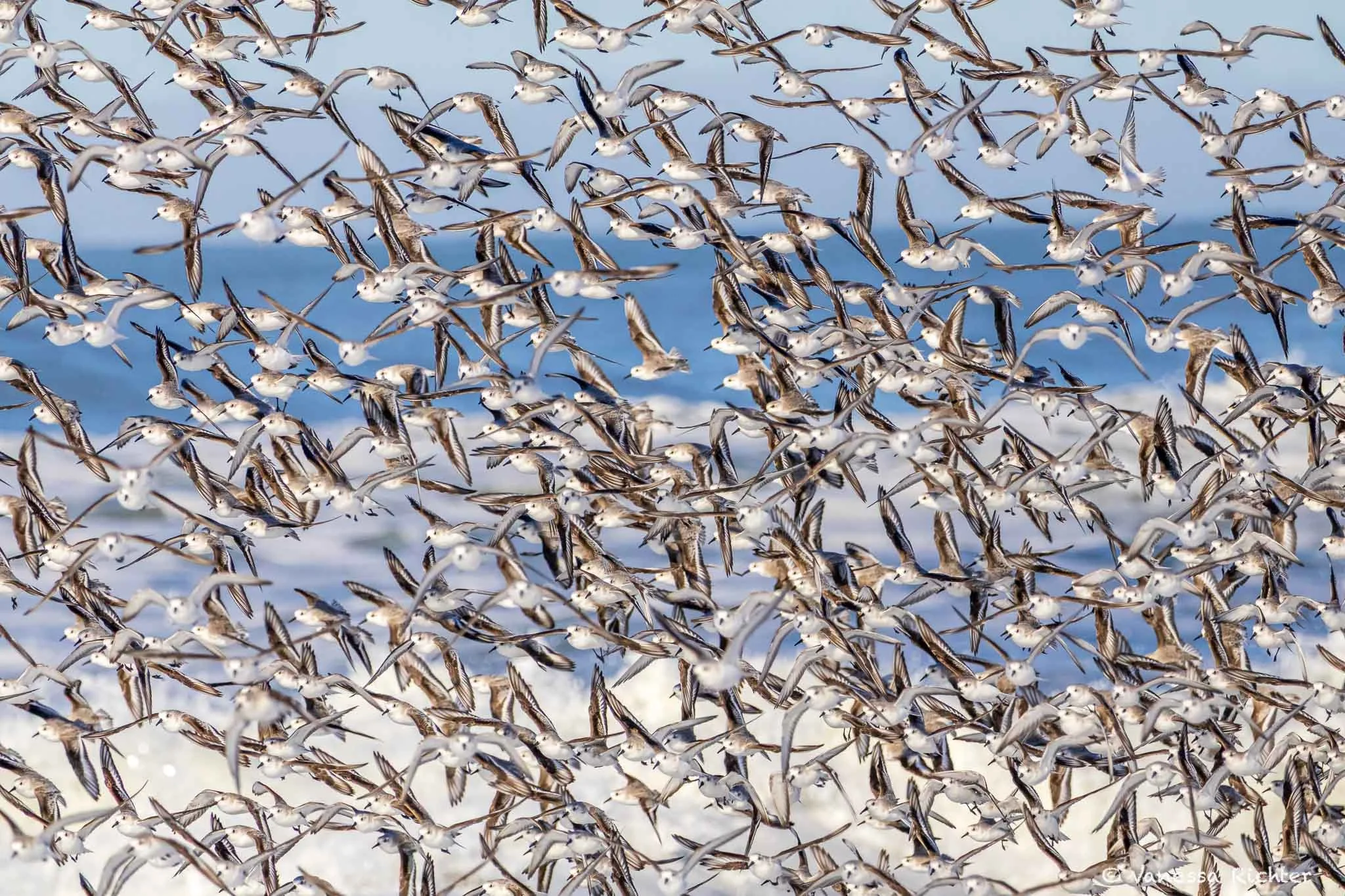
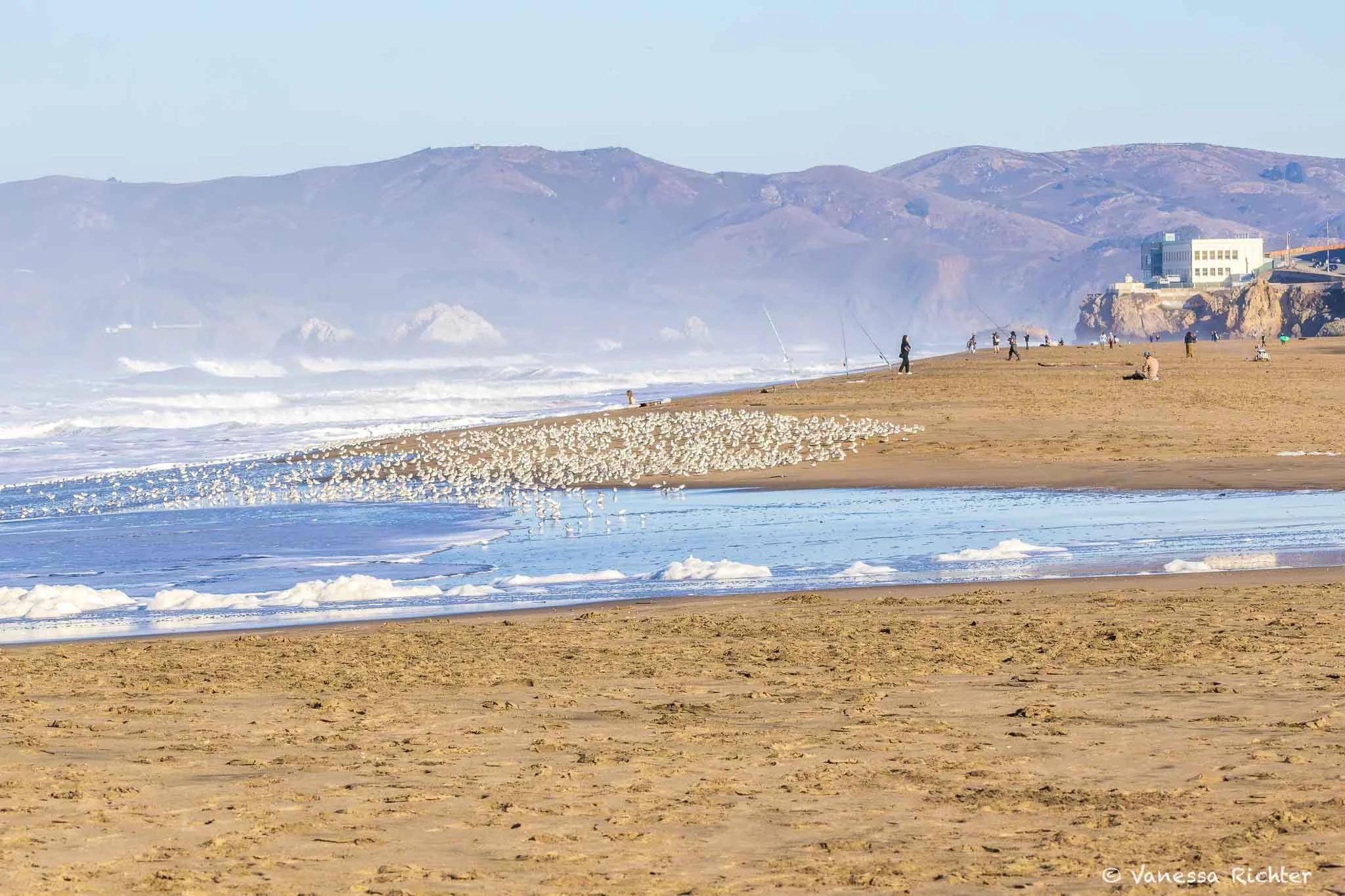
From afar, it looked like a big white cloud changing shape constantly, fluidly and yet in a way that seemed as if it was following clear rules. The cloud was moving along the sand under a deep blue sky with the morning sun reinforcing the white’s brightness. Unlike a real cloud made of countless water droplets and ice crystals, this cloud had a different foundation, consisting of dozens of individuals, each with their own head yet bonded together like water molecules. I had just driven across the city, through construction sites, countless four-way stops, even more traffic lights, past beautiful Victorian homes, all of them worth a fortune, and now I was standing at the edge of it all, in front of me only sand, wide-open water and a thick cloud of birds. My gaze looking out to the horizon beyond the crashing waves, the next place in this direction with human civilization: Hawaii, hours away by plane. In San Francisco, it is sometimes hard to comprehend how much beauty there is, in so many different ways no matter where you look and how close and intertwined urban life and wild nature are.
Here, the beauty spoke David Attenborough nature documentary level. Slowly, I made my way through the sand, gently pushing away the grains with my barefoot shoes, and walking toward that cloud made of sanderlings. I instinctively had to smile. It was just too beautiful to see these small birds so tightly connected to each other, moving together, resting together and always staying in formation even when the shape of their bond changed. Well, except there was one thing that made the birds break their invisible rule: Food, of course. Maybe you could say that the process of making a catch isn’t entirely ruleless. It seemed to follow two specific guidelines: protect what’s mine and steal from others. Not exactly polite, but a sanderling has to do what it has to do to stay well fed.
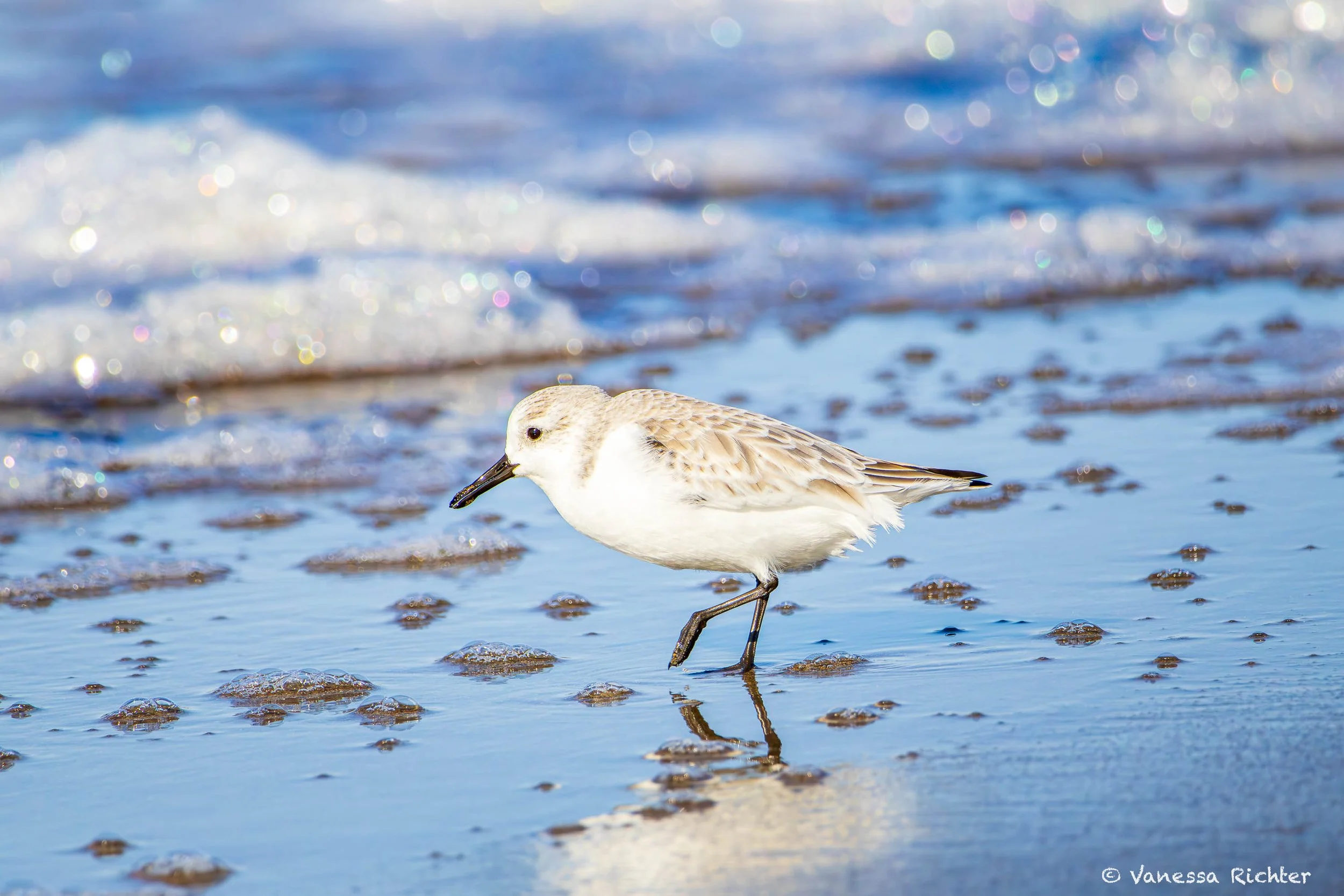
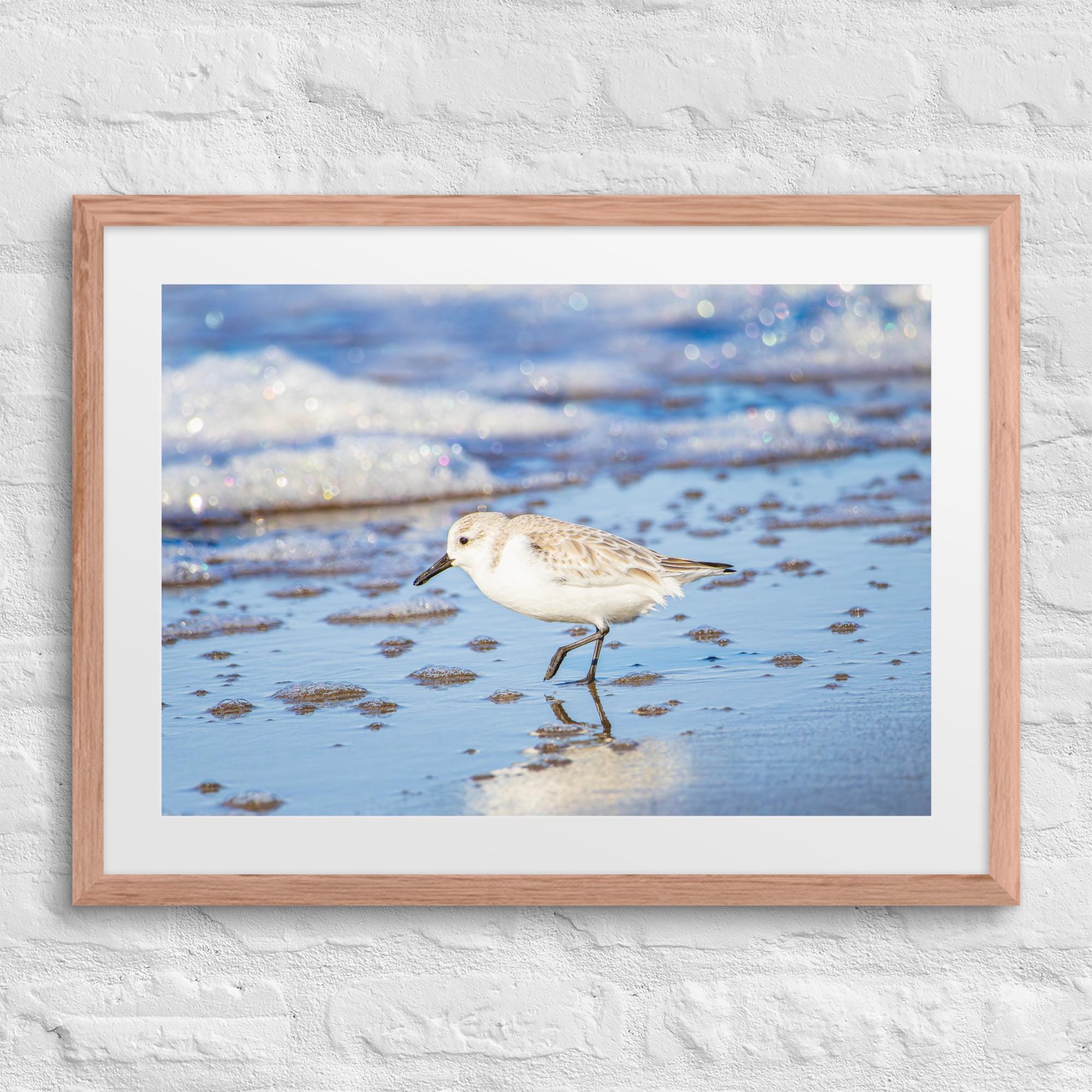
Isn’t it lovely how beautifully the droplets in the ocean foam light up in the background? But of course, the star here is the sanderling wading so gracefully through the intertidal zone on its tiny legs.
This photo is available printed and framed with a mat in my Etsy shop. Use code VENTUREBEYOND for a 10% discount.
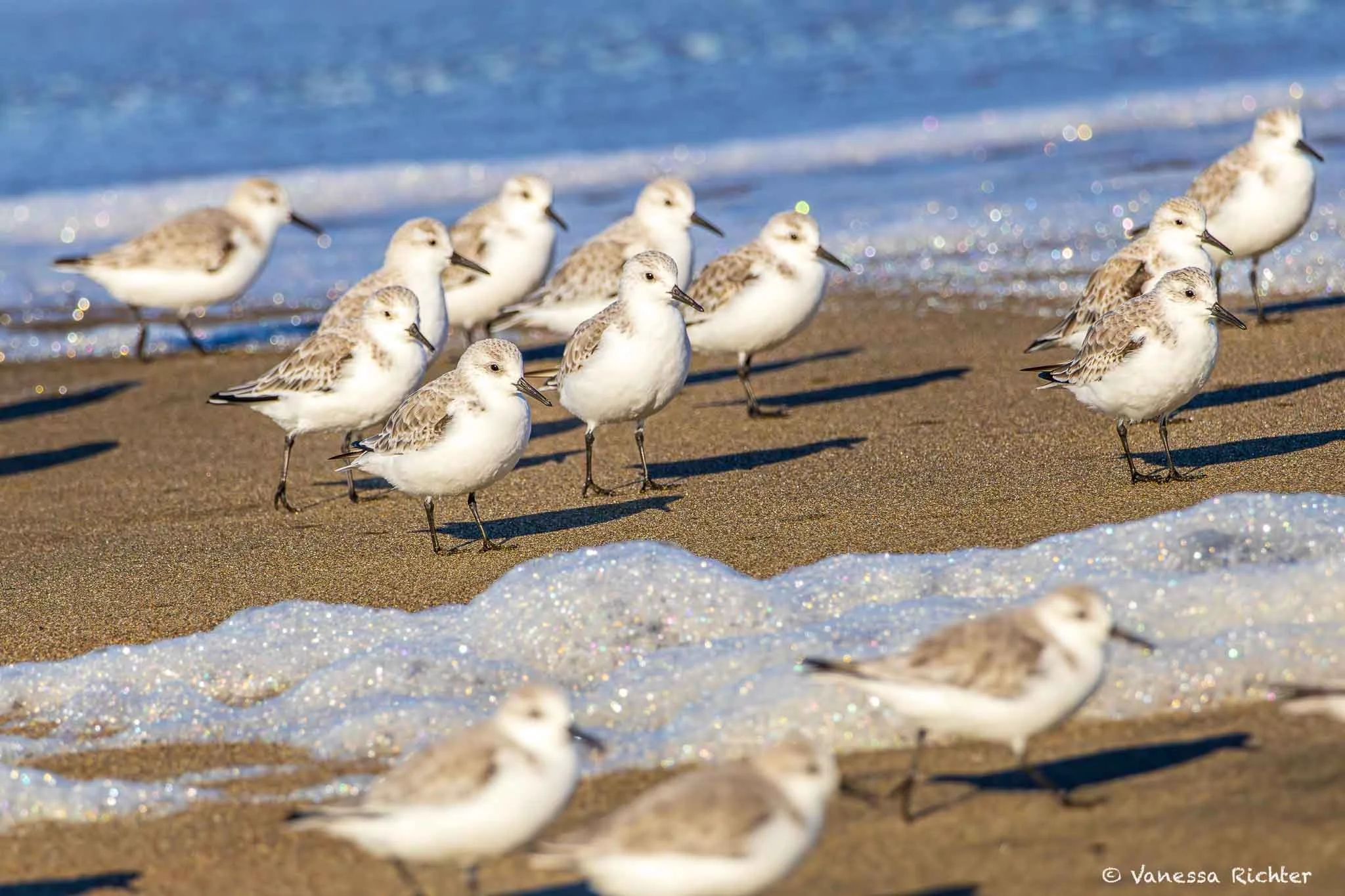
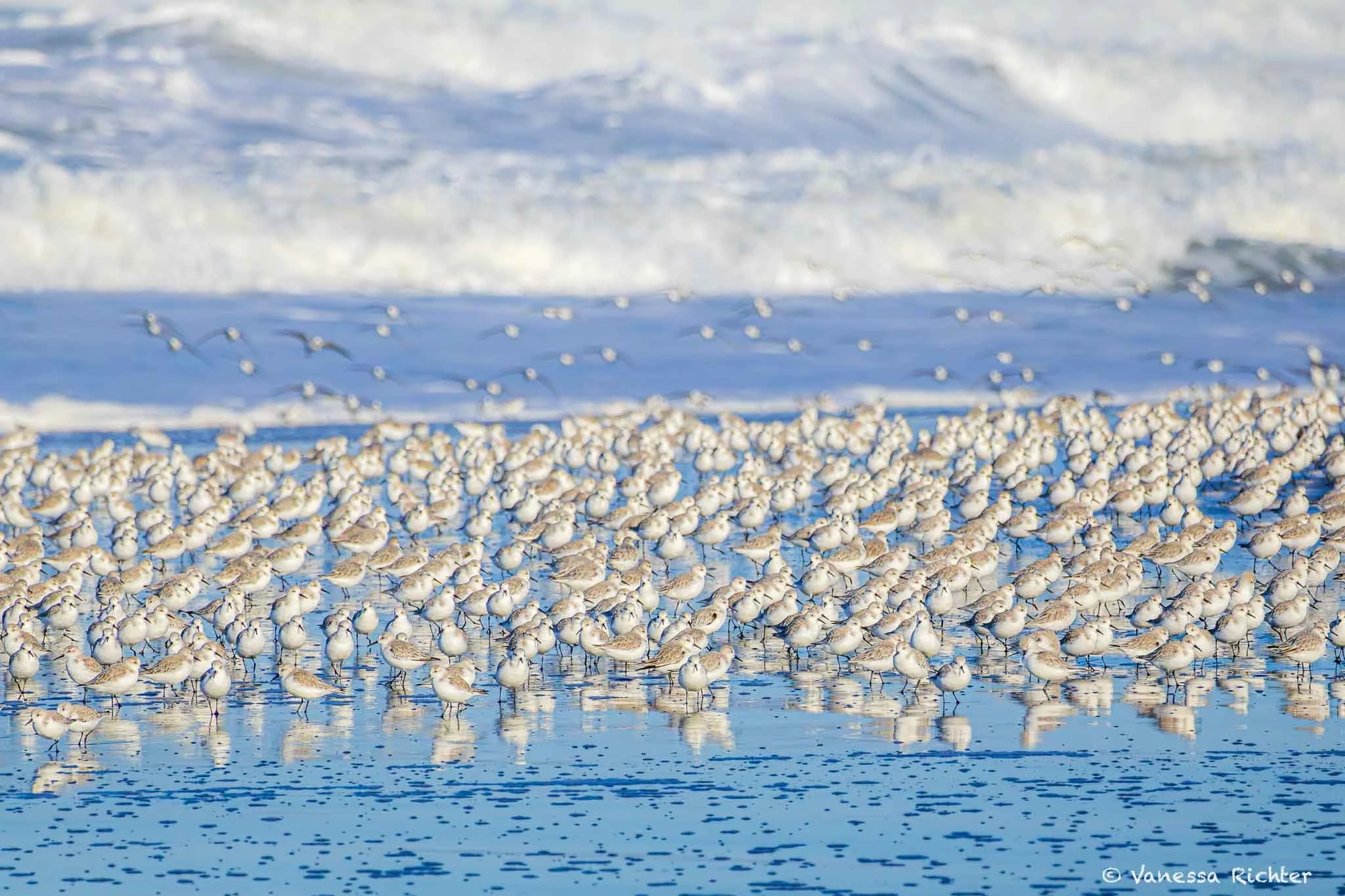
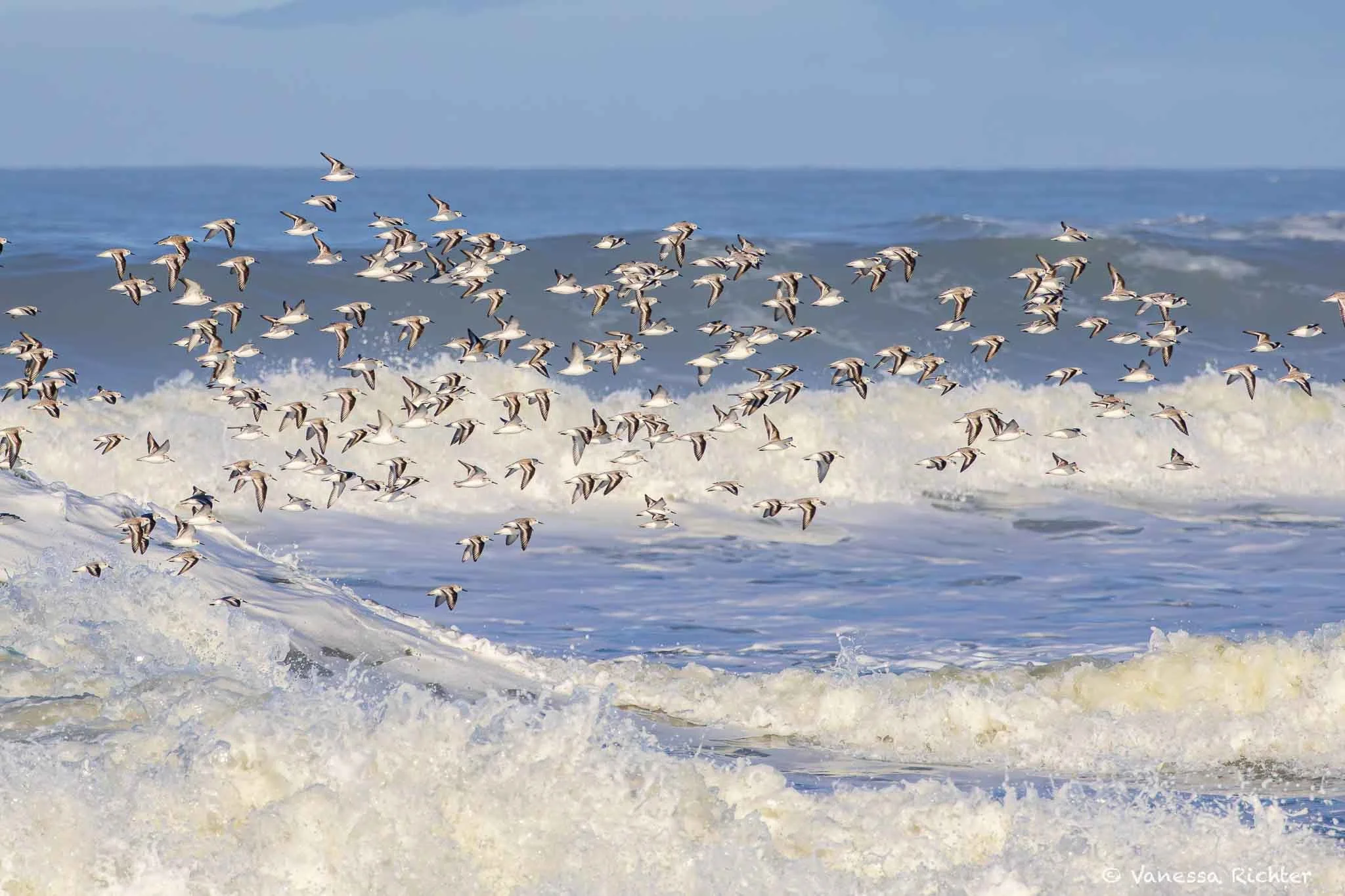
The large flocks of sanderlings undeniably consumed my attention. And their magical pull hasn’t lessened over the years I have been coming to watch them. Yet the magic is not just the birds. It is also them together with the ocean at this time of year. The time when big storms make the Pacific even wilder. Storms that may not even make landfall in California, but that brew elsewhere, reaching the California coast only through waves and foam. Because the waves have more energy than in summer, they break earlier, and the zone where the water may flood beyond the breaking zone gets wider and less predictable. Together with the foam that looks as if it should only exist in your bathtub, this creates the most dreamy setting for the birds to forage in. Sometimes the water presses forward like a flat, expanding mirror taking the shining foam balls far onto the beach. Then the birds (and the photographer) have to be quick: they run toward the ocean and start to pull crustaceans out of the flooded sand as fast as they can, running back with their tiny legs moving at lightning speed when the next wave hits.
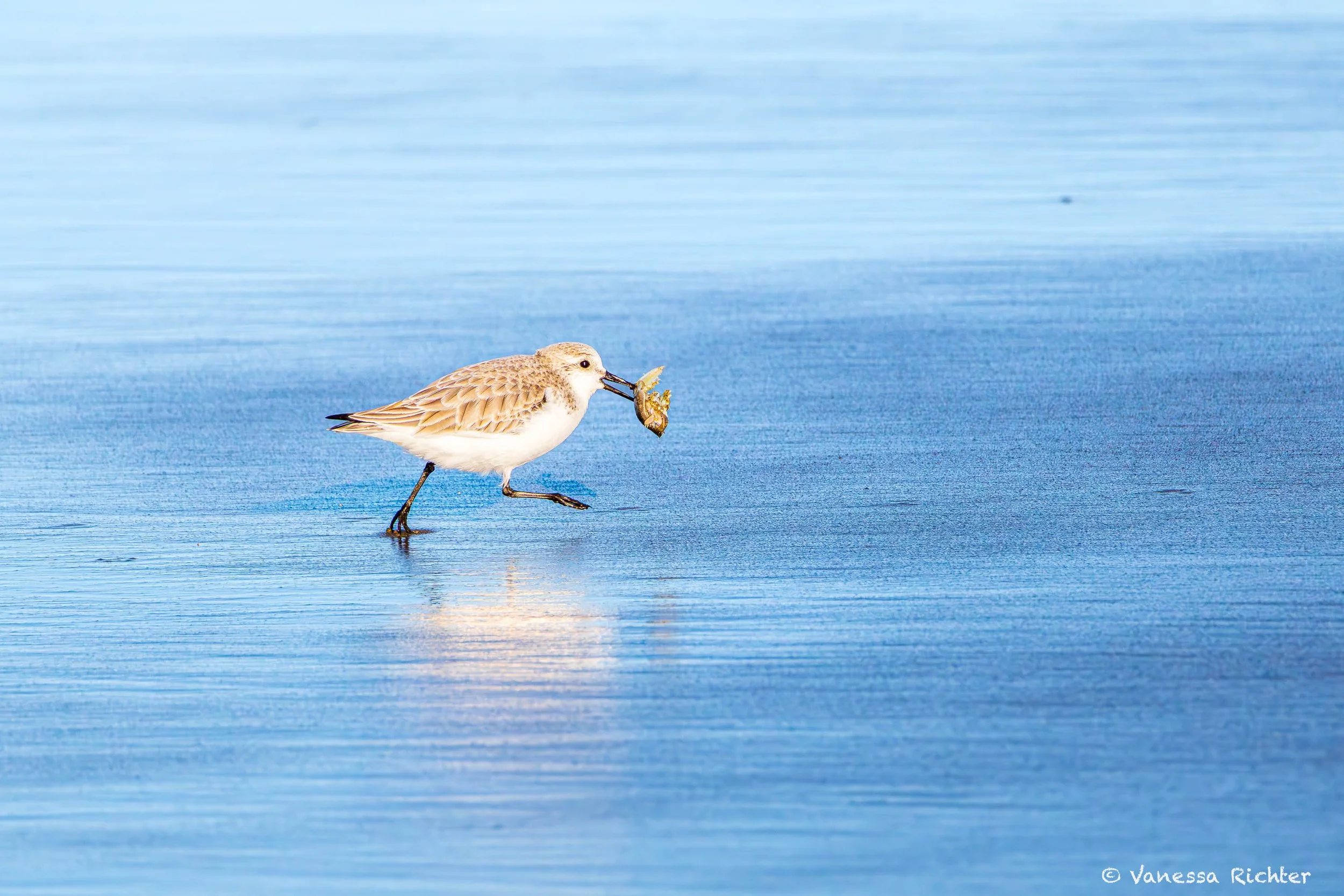
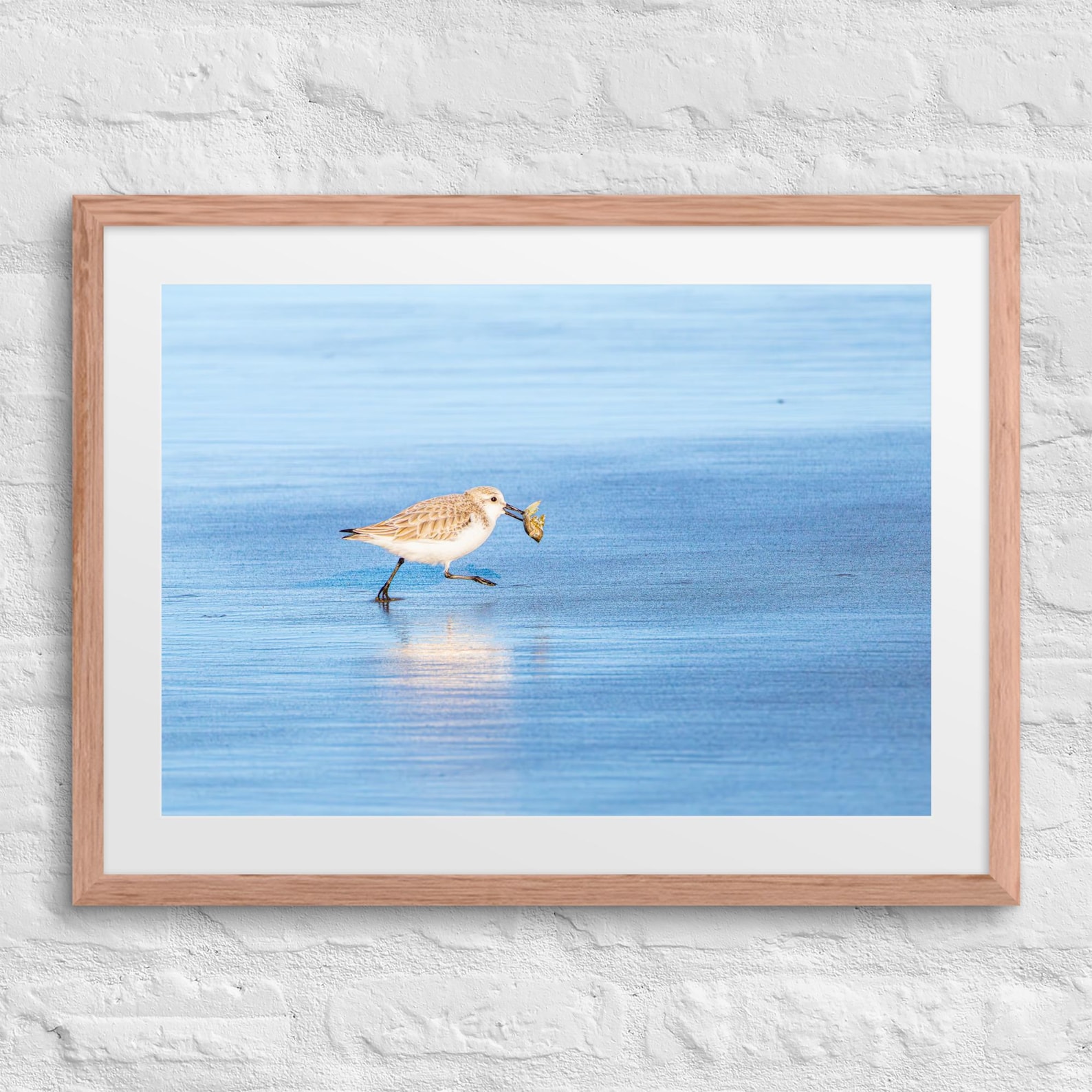
It almost appears as if this little guy is walking on water when in fact it is running across a very water-saturated layer of sand that creates this visual mix of deep ocean blue on textured grains. This sanderling was lucky to catch a really big piece of a crustacean. After the catch, it’s time to run as fast as possible because this superb meal won’t go unnoticed by its buddies!
This photo is available printed and framed with a mat in my Etsy shop. Use code VENTUREBEYOND for a 10% discount.
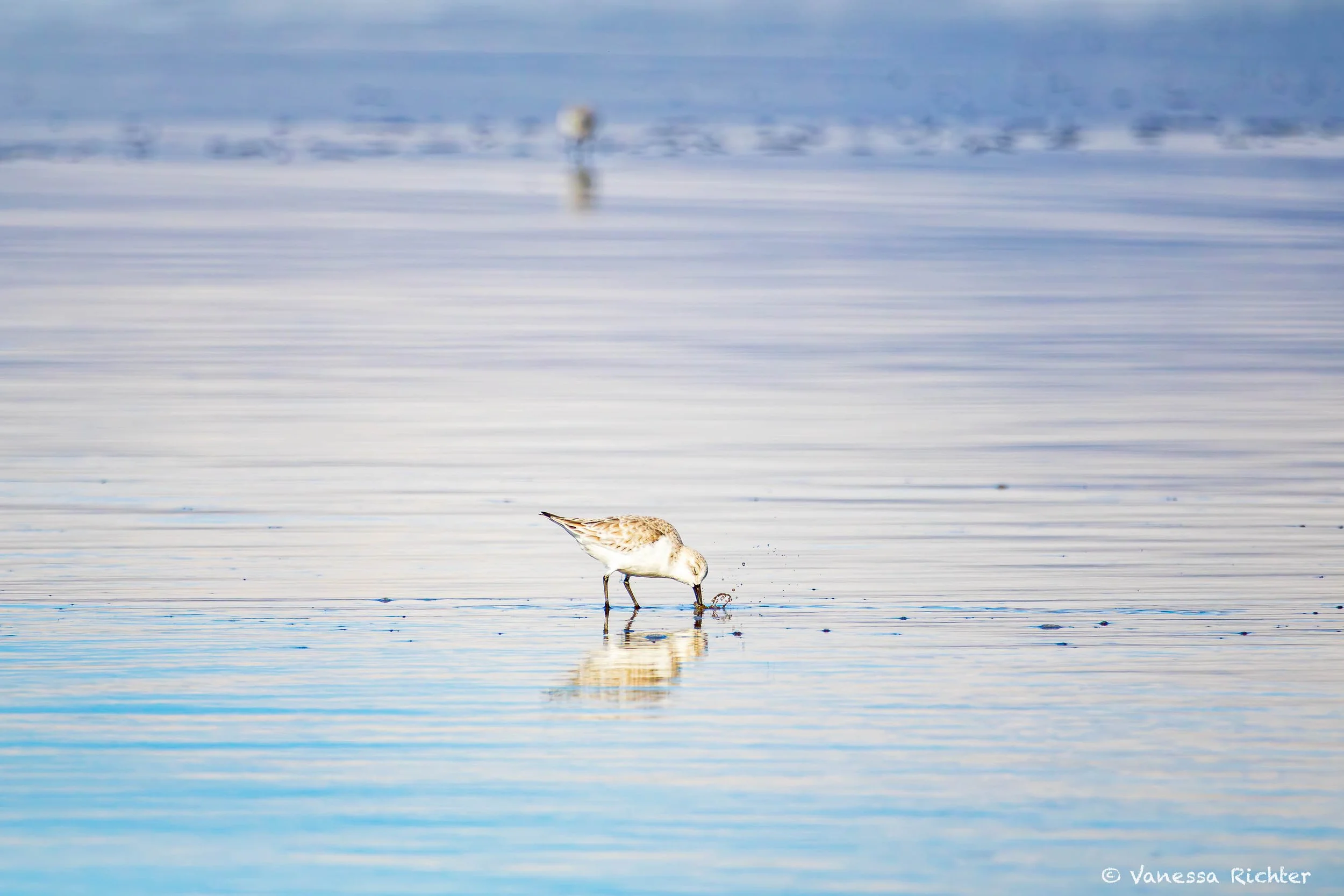
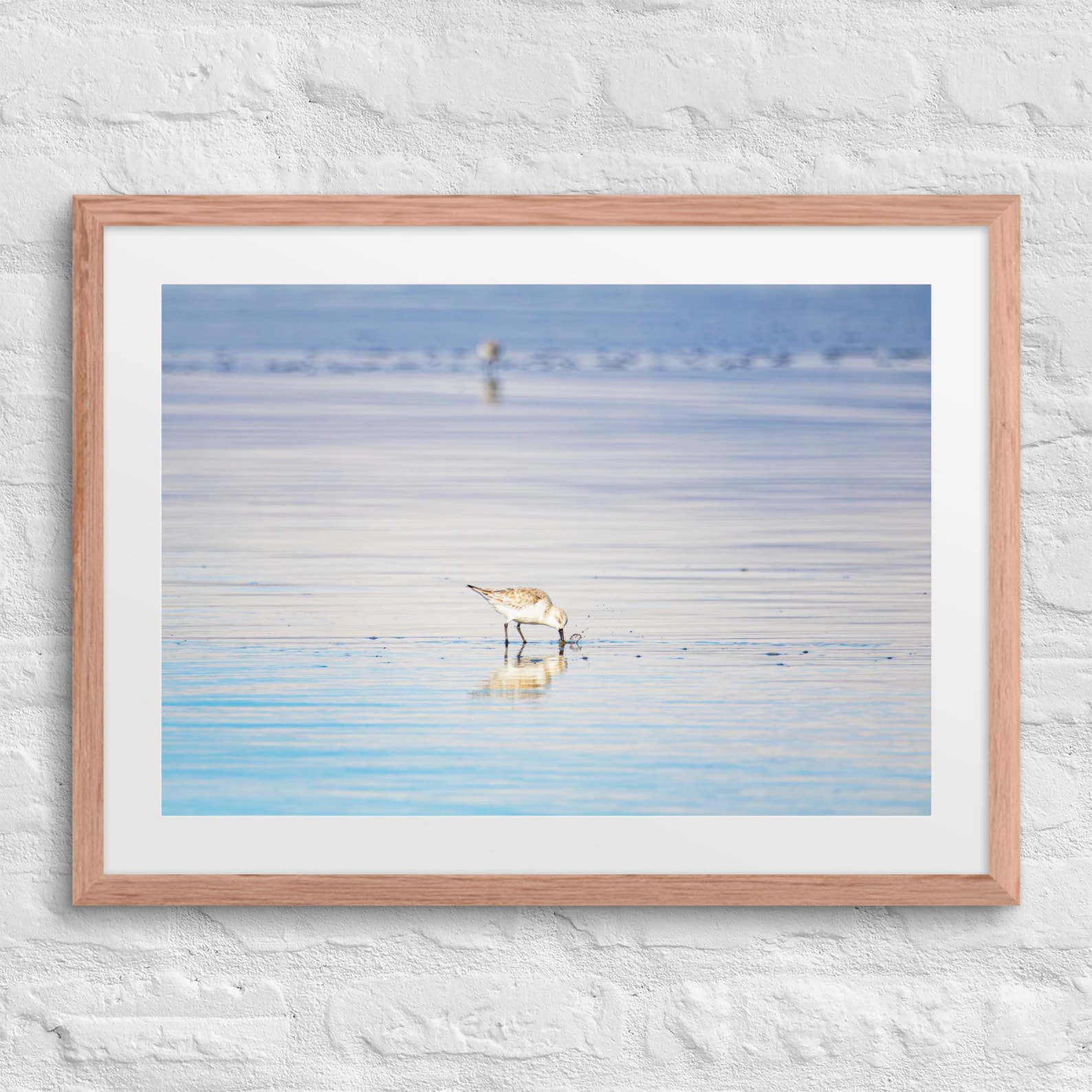
When you watch the sanderlings along the shore, you’ll notice that their movements are so quick, and they are so small, that it can be hard to see what is actually going on. But their motion frozen in a photo shows how dedicated and almost meditative they look when they search the muddy sand for food.
This photo is available printed and framed with a mat in my Etsy shop. Use code VENTUREBEYOND for a 10% discount.
A Lone Bird
In the midst of all the sanderlings, there was another bird species wading gracefully along the shore: a Marbled Godwit. Just a single bird. Like the sanderlings, the Marbled Godwit had already arrived for the winter. Most likely, it didn’t have to travel as far as the sanderlings, though; Marbled Godwits breed mostly on the northern Great Plains, with just a few localized populations at James Bay, Ontario, and on the Alaska Peninsula. However, outside the breeding season, this bird is typically social, traveling in groups. I looked around again, but it was all by itself.
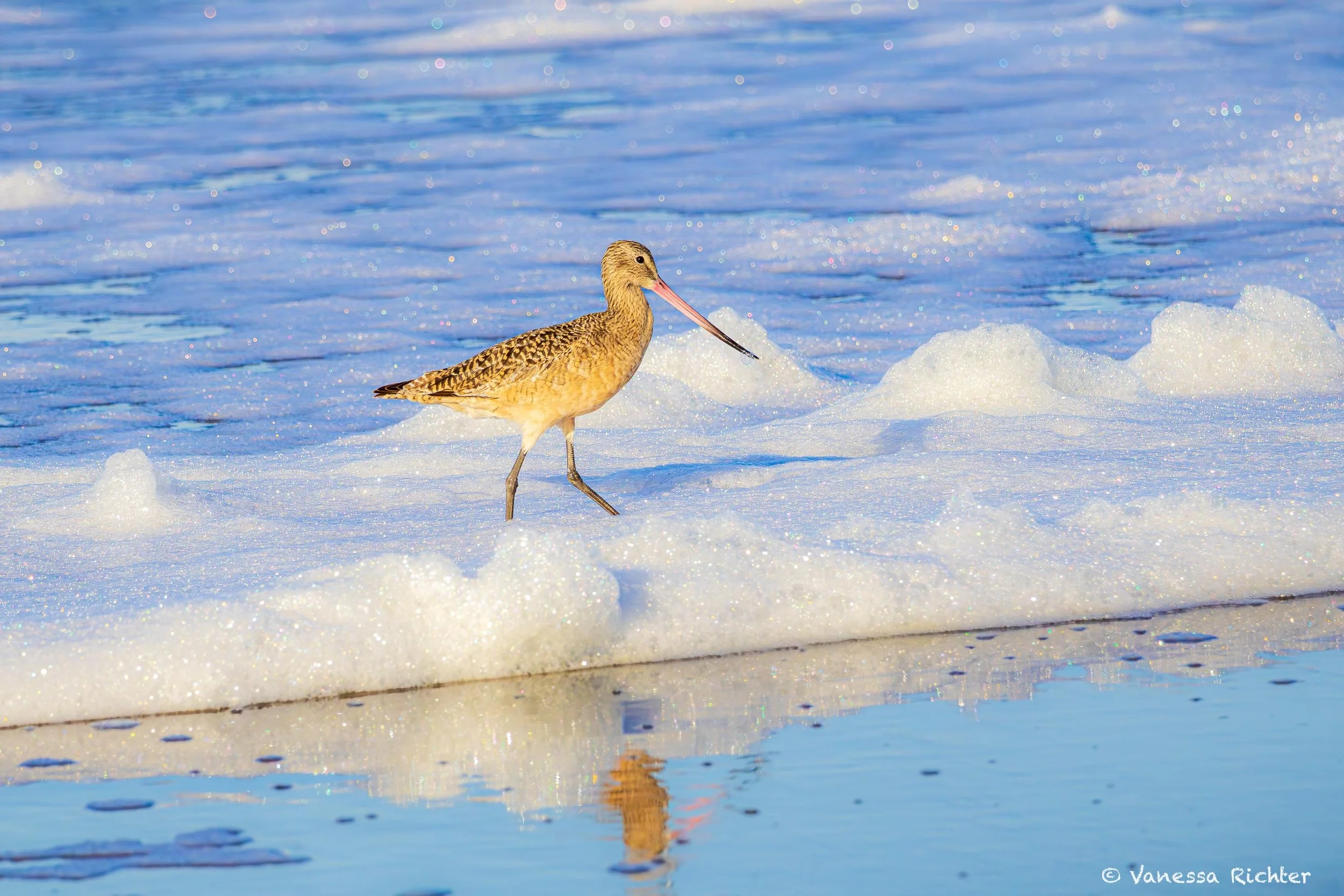
This Marbled Godwit (Limosa fedoa) walked so gracefully through the foam, looking for food. It had probed the foam-covered sand earlier, and when you look really closely at this picture, you can still see the foam around the tip of its bill.
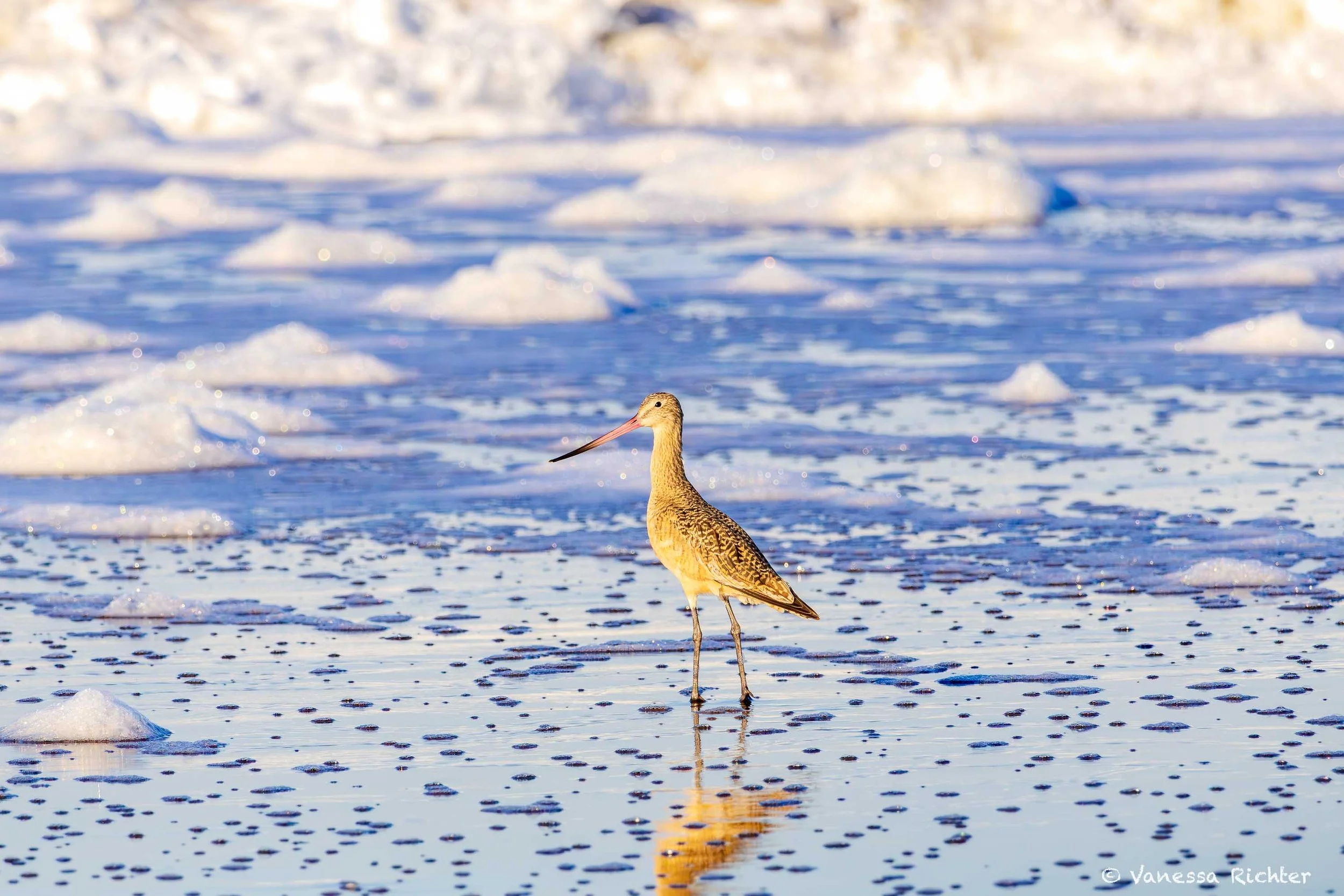
I couldn’t stop photographing this lone Marbled Godwit; it was just too beautiful. It almost appeared as if it knew exactly how to pose for the camera. After a while, it seemed that it was time for it to go, maybe in search of its flock, maybe to find a better place to feed. It just spread its wings, lifted up its long legs and flew away.
Hiding In Plain Sight
As I continued walking along the beach, getting a bit more distance from the edge of the water, something else caught my eye, but the moment lasted just a fraction of a second until I lost what I had laid eyes on. I stopped and tried to focus on the details, which was no easy task looking at a seemingly uniform pile of sand. I started to notice how the beach had all these holes and gentle piles, spaced in such an even way. Around the holes, there were impressions imprinted in a pattern. And then, I finally saw again what had caught my attention: small fluff balls, their heads as beige as the sand, sitting in these holes. Each of them having their own, keeping a distance from each other, yet close enough to stay connected. The impressions: dozens and dozens of bird footprints. Visually, these birds resembled the sanderlings in many ways, yet they were a different species. I was looking at snowy plovers.
A Threatened Species: Western Snowy Plover
The Western Snowy Plover (Charadrius nivosus nivosus) is about the size of a sparrow with gray legs, a short black beak, and snowy white underparts. Its appearance changes depending on whether an individual is breeding or non-breeding. I photographed the snowy plover in the photo below in November outside the breeding season, so it lacks the black patches around its head that it would have as a breeding adult!
The Pacific coast population was declared federally threatened in 1993 due to habitat loss and degradation from beach development and invasive dune plants, along with human disturbance and predation. Snowy plovers are ground nesters, and easily startled by unleashed dogs or even flying kites! If that happens during the nesting season (March to September), they may abandon their nest and leave the eggs unprotected.
Read more further below in Know Before You Go.
Sources: Audubon: Western Snowy Plovers in California · NPS Channel Islands: Snowy Plover · Center for Biological Diversity: Western Snowy Plover
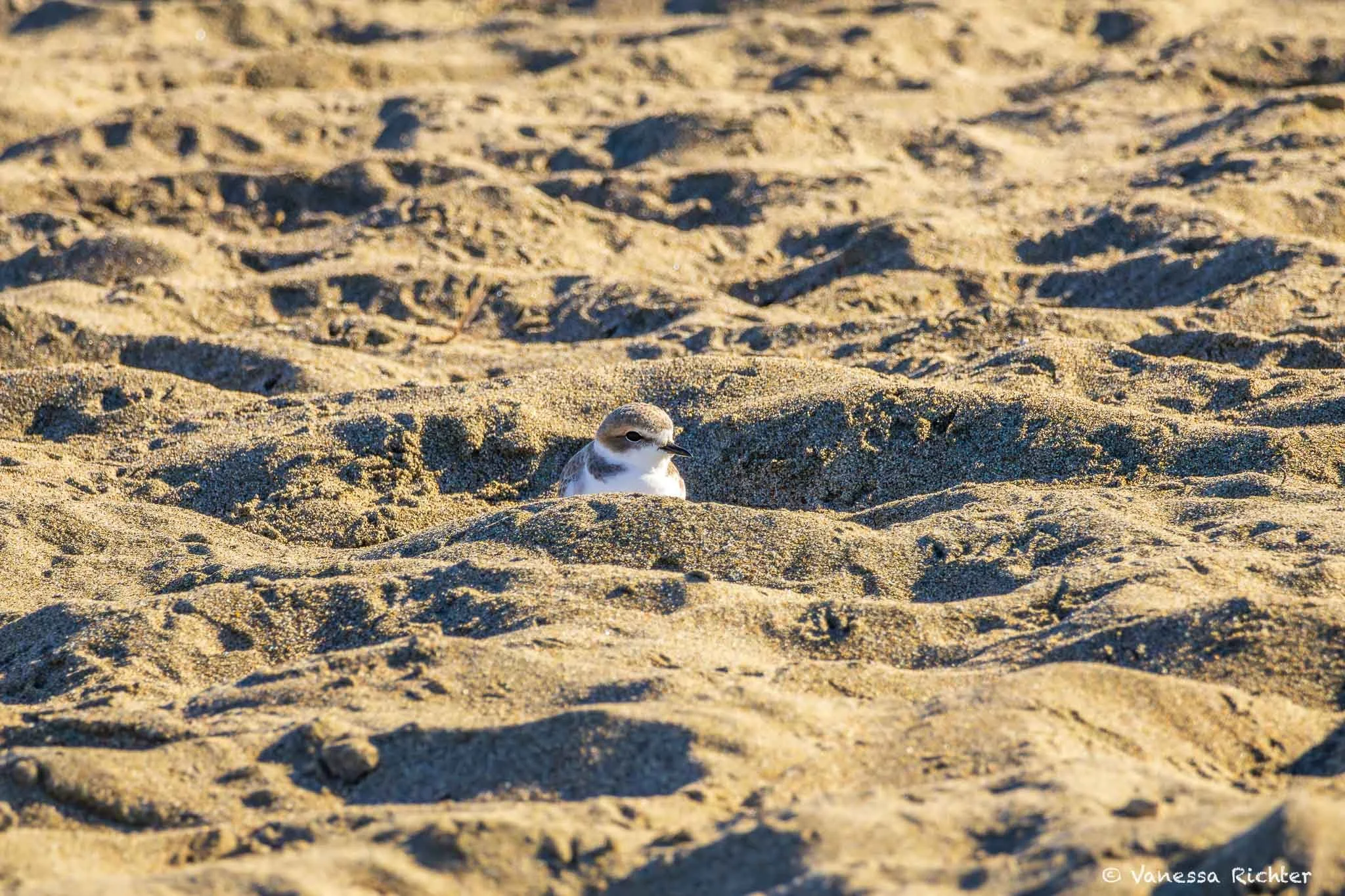
Once I had noticed one snowy plover, then two, then three, I realized that the entire area above the wet sand was their resting area. I kept walking along the wet sand, always on the lookout for the next wave that may push the foamy water further in. I kept seeing groups of sanderlings: some resting a little further away from the ocean; some feeding.
And some flying away like those big, white clouds.
Know Before You Go
Best Time & Birdwatching Tips
- Season: Marbled godwits and sanderlings are at the coast from fall through spring. In my experience over the past 3 years, I saw them in large numbers most reliably from November to February. The birds will be there in any weather :). There is no exact location where they usually hang out. The sanderlings move around a lot, and there are typically several groups, so anywhere along the beach can be great. Marbled godwits can be more elusive at Ocean Beach (I just saw one for the first time this year), so just let nature surprise you.
- Timing: I recommend going in the morning when the light is soft and the wind is calmest.
- Binoculars: For birdwatching in general, and in this case especially for watching snowy plovers because they are threatened and need plenty of space, I highly recommend bringing binoculars. I use two different pairs that I am happy with for different purposes:
- These hiking binoculars* keep things super light and compact.
- This is my favorite medium-size pair for a very clear and more detailed view*, which I prefer to bring when I am not hiking far or when I know that the extra space and weight will be worth it.
- Field guide: I use iNaturalist and Merlin for quick identification and logging species. I also highly recommend National Geographic Field Guide to the Birds of the United States and Canada*, in which you will find detailed illustrations of birds by sex, breeding/non-breeding, juveniles vs adults, detailed descriptions of their visual features, range maps, and more.
Leave No Trace
- If you are not familiar with it, it is worth checking out the Leave No Trace website to learn how to recreate responsibly.
- Most importantly: leash your dog around the birds. There are sections at Ocean Beach where leashing is required because of threatened snowy plovers, which see dogs as predators and flee when a dog runs toward them. Dogs also love running after the sanderlings (or any bird). While sanderlings are not globally threatened, the 2025 State of the Birds report lists them as having lost more than 50% of their population in the past 50 years. Being chased around makes them spend their energy on constantly fleeing instead of feeding. On my last visit, I saw A LOT of snowy plovers on the sand in a zone that did not have a sign. If you want to protect the birds, there is nothing better you can do than keeping your dog on a leash.
- Snowy plovers: If you see one, do not approach it and avoid the area. They sit in the dry part of the beach and can be hard to spot because they blend in so well with the sand, and there are usually many more! Sticking to the wet part of the beach helps protect them. Be careful, though, to not get too close to the water and never turn your back on the ocean.
- When the sea is rough, there is often more trash than usual washing up along the shore (plus the “regular” trash that people leave behind right on the beach). Consider bringing a bag if you’d like to help remove it. But even if you just have a free hand for a small plastic cap, it is still one less piece of plastic in the ocean!
My Ocean Beach Photography On Etsy
Click below to browse my full shop and see all available prints. Use code VENTUREBEYOND for a 10% discount.
Note that I continue to add prints, so it is worth checking back. However, if there is a photo that is not yet in the shop, but that you would like to have printed and framed, please just drop me a message to vanessa@venturebeyondthepicture.com or directly through Etsy. I'm happy to take requests.
Read On

Follow the Adventure
Latest on the Blog
Looking For Something?

Once Glacier Point Road closes for the season, hiking the Four Mile Trail becomes the only way up — and there's only a short window before ice and snow close that trail too. This narrow stretch of late fall is the absolute sweet spot for the hike: more solitude at the top, ideal temperatures for the climb, and golden late-fall light. Here's everything I learned hiking it on a sunny late November day, including what you need to know to be fully prepared.