
Visiting Anchorage in Winter: Snowy Hikes, Scenic Drives & Fascinating Wildlife



This post contains affiliate links. If you book through them, I may earn a small kickback at no extra cost to you, which helps me write free resources like this one — thank you for supporting my blog.
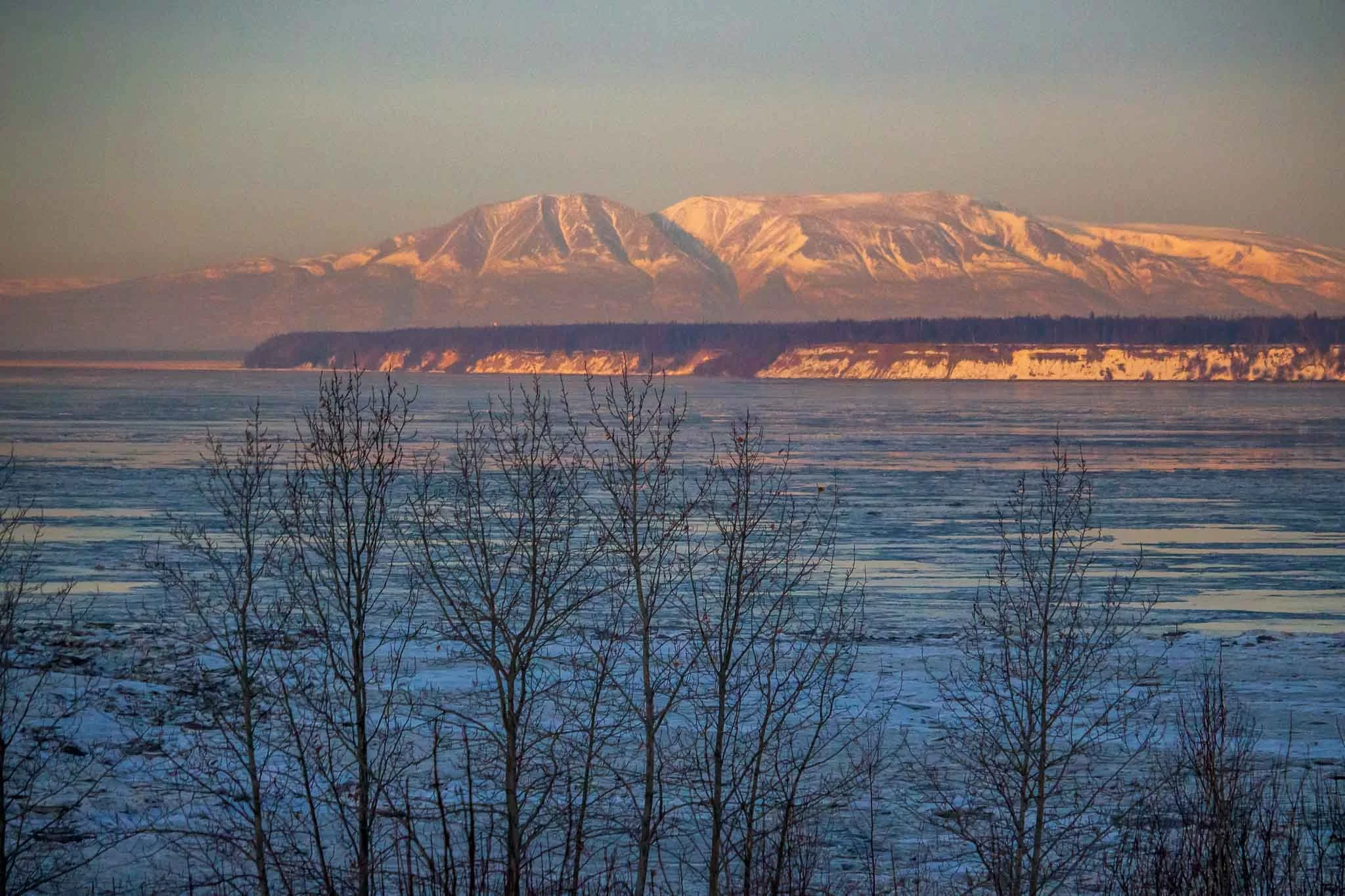
Anchorage is located right on the Cook Inlet (a bay of the Pacific Ocean) to the west and framed by the Chugach Mountains to the east. While Anchorage is most popular during the short summer, it is as stunning in winter, when snow covers most of the landscape and ice creeps across the water.. It is, though, one of the more moderate places to visit in Alaska when it comes to weather, due to its closeness to the ocean and the maritime influence.
In this article, I'll share with you what outdoor activities — yes, you heard right — I enjoyed around Anchorage during the colder season. Spoiler alert: Anchorage is an outdoor paradise year-round, not just summer.
If you're already shivering, grab something cozy, and I'll spill the tea on all the great winter things to do here.
Kincaid Park: Hiking, Moose Watching & Sunset
Anchorage truly amazed me with its charming bake shops, bars, and restaurants, while being so close to nature. One park on the very western edge of Anchorage that you shouldn't miss is Kincaid Park. It's a fantastic spot to observe moose while hiking to the coast. Since we were eager to see a moose and I had read that this is a park where moose are commonly seen, it was an easy choice—and we were fortunate enough to spot one.
Tony Knowles Coastal Trail To Beach
Beyond the possibility to see moose, the park is a great place to strap on your snowshoes or microspikes (check conditions before heading out), and hike through the snow while surrounded by nature. We parked at the Chalet parking lot in Kincaid Park and then followed the Tony Knowles Coastal Trail to the beach. Here is a map of the Kincaid Park trails to help you navigate the trail network. If you arrive near sunset like we did, you may be rewarded with one of the best sunsets you've seen in your life. The sky turned into an explosion of orange, the water with ice floating on the surface blanketed in reddish hues, and the air so crisp that I can almost feel it now just writing about it.
By the way, we later saw another moose right at our vacation rental in Anchorage too—so be patient, the chances of seeing a moose are quite good in Anchorage.
Turnagain Arm Scenic Drive
Imagine gazing over the ocean, the water flowing like a river carrying pieces of glimmering ice on its surface. In the distance, the towering snow-capped Chugach and Kenai mountains frame the setting. On an exceptionally clear day, you can even see across to the Alaska Range. As you watch the chunks of ice drift on the calm inlet, the sun is lingering low on the horizon. You check the time: It is almost noon, but it seems that the sun has been in sunset mode since sunrise.
This is how I'd summarize the overall mood for the drive from Anchorage to the Kenai Peninsula along the Seward Highway. With inspiring views around every corner, the Seward Highway is a designated USDA Forest Service Scenic Byway, an Alaska Scenic Byway, and an All-American Road. It will take you right along the so-called Turnagain Arm.
There are plenty of pullouts along the road where you can pause to take in the scenery, or stretch your legs and explore a bit. Here's where to hit the brakes in winter (places ordered from north to south):
Potter Marsh Wildlife Viewing Boardwalk
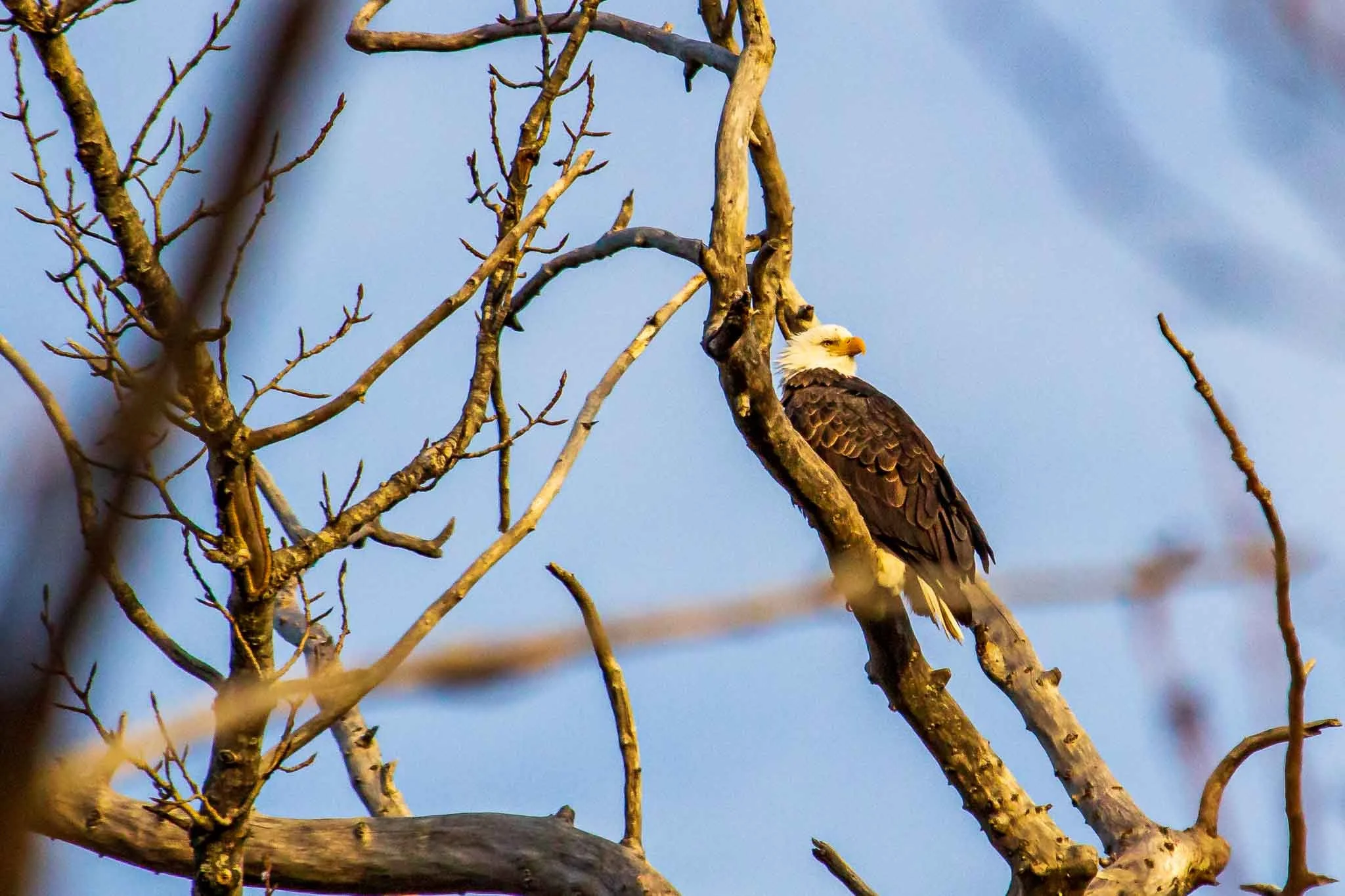
Walk above the frozen marshland on a wooden boardwalk and take in the quiet winter landscape. The creeks here often freeze over, and wildlife stands out against the snow—especially moose, whose dark brown fur makes them easier to spot. Keep your eyes on the skies, too: Bald eagles are frequent visitors. We were lucky enough to see one perched nearby.
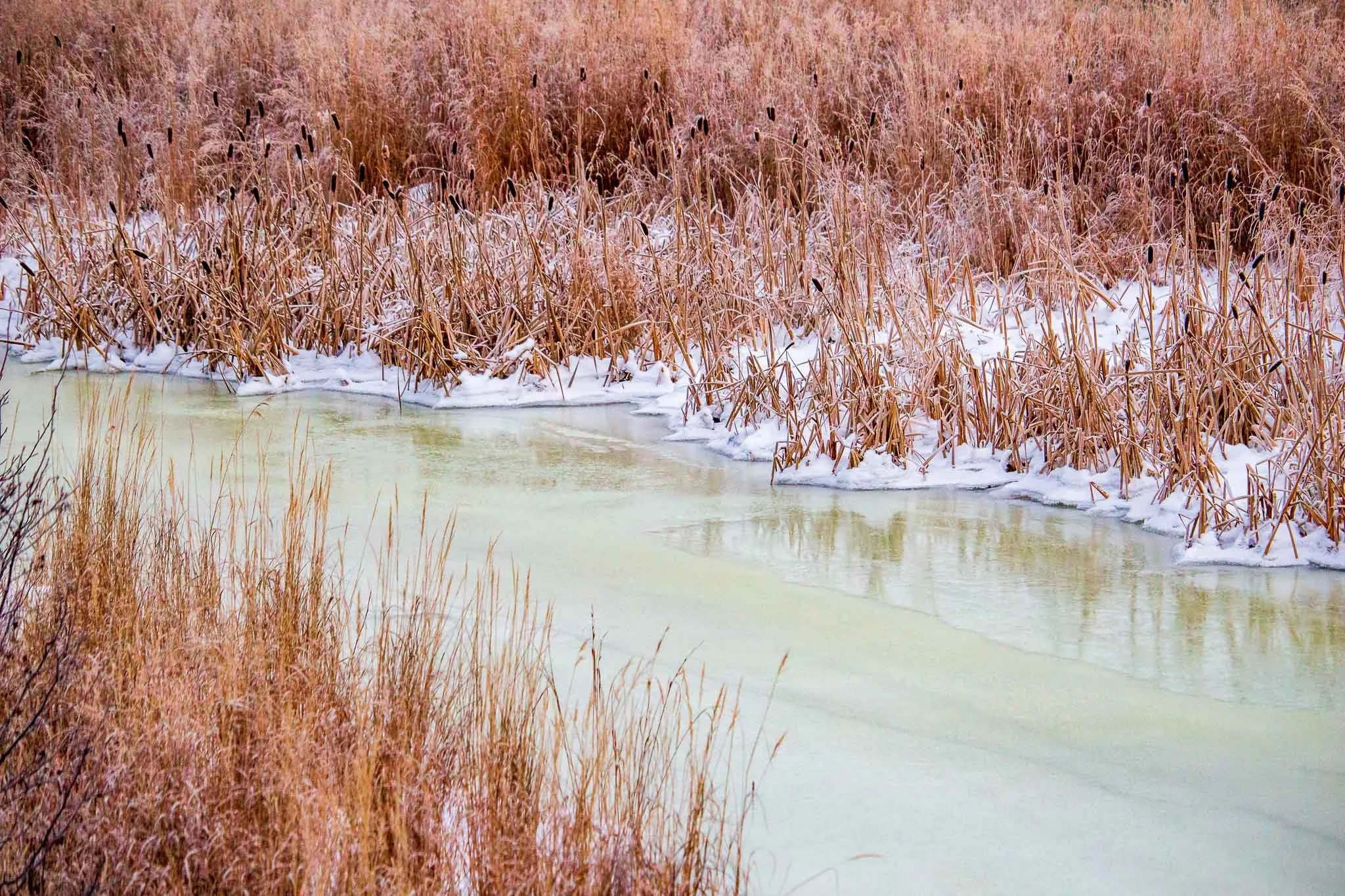
Views of the frozen marsh. I love how the brown reeds add a pop of color at this time of year.
Beluga Point
A dramatic highway turnout offering 180-degree views of Turnagain Arm, with spotting scopes and interpretive signs. We enjoyed so much just watching ice floes float on the water that seemed so still, yet moving quite fast with the golden-glowing sun and mountains in the background.
It got its name from the small, white beluga whales that travel up and down the inlet and can be spotted from this location at certain times of the year. CIBW has been collecting sightings data for several years, and according to them the best time at this location and others close-by like Bird Point is between mid August through October and generally 3-4 hours before Anchorage high tide. Depending on ice conditions, they may be seen until December at this location. We weren't fortunate to spot them at the end of November, but you may get luckier than we did.
This is also one of the best vantage points to catch the bore tide when conditions are right. A bore tide occurs when the difference between low and high tide is large and the incoming tide rushes through a narrow channel, such as a river or estuary, often against the current. The incoming wave, which can reach 6 to 10 feet in height and travel at speeds of 10 to 15 miles per hour, typically arrives an hour or more after low tide (so this has to be timed really well).


Bird Point
A little further south, Bird Point is another excellent pullout with sweeping views of Turnagain Arm — and another good vantage point for watching the bore tide or spotting belugas at the right times.
Girdwood
About 45 minutes from Anchorage, the small village of Girdwood is home to Alyeska Resort, Alaska's premier ski resort. Even if you're not skiing, it's worth a stop. The aerial tram runs year-round and offers views over the valley and mountains.
Alaska Wildlife Conservation Center
The Alaska Wildlife Conservation Center is a non-profit sanctuary set on over 200 acres where orphaned and injured animals are given a permanent home in large, natural habitats. The sanctuary is home to a wide range of species — from wolves, moose, and brown bears to wood bison, muskox, and caribou to smaller residents like foxes and porcupines. Through a partnership with the US Forest Service, an additional 110 acres are leased specifically for wood bison.
🌟 My Recommendation For The Turnagain Arm Scenic Drive
If you're combining the drive with exploring the Kenai Peninsula, I highly recommend starting early and sticking to the shorter stops like Potter Marsh and Beluga Point. You probably won't have time to explore the Alaska Wildlife Conservation Center or make a longer stop in Girdwood, since daylight hours are short in winter.
If you do want to visit Girdwood or the Wildlife Conservation Center, make a full day trip of it and save the Kenai Peninsula for another day.
Don't want to deal with the drive? This guided day tour covers the Turnagain Arm highlights and includes a visit to the Alaska Wildlife Conservation Center.
Kenai Peninsula
When you reach the Kenai Peninsula, keep your eyes peeled for bald eagles. They are common here, often perched in tall trees, on high poles, or soaring overhead. We saw them right in the middle of Seward, perched on a pole and in a tree.
Kenai Fjords National Park
The Kenai Peninsula is home to Kenai Fjords National Park which is technically open in winter. However, the road to Exit Glacier, that many come to see, is closed to vehicles from around late October to May each year depending on snow conditions. During that time, you can travel the road on cross-country skis, snowshoes, fat tire bikes, dogsleds, or snowmobiles (latter only when explicitly allowed, otherwise prohibited, check conditions first).
While Exit Glacier is a short stop in summer, it will be a longer trip in winter. From the first closed gate to Exit Glacier, it is a further 7 miles (11.5 km), and an additional 1 mile to the Exit Glacier Overlook. So, if you plan to see the glacier, plan your mode of travel before you head out and the time needed to get there accordingly.
Note that boat tours into the park run seasonally from late spring through early fall and are not available in winter.
In addition to the national park, there are even more places to explore on the peninsula. When we visited, we opted for a different hike that was just perfect after the scenic drive.
Bald eagle perched on a branch in Seward.
Our Hike Pick: Tonsina Creek Trail
Lowell Point State Recreation Site · Kenai Peninsula · Alaska
Tonsina Creek Trail
View on AllTrails →Scan for map & details
📏
3.2 mi
5.1 km
Distance
⛰
652 ft
199 m
Elevation
🔁
Out & Back
Route
In winter, you have to consider that not all trails are accessible, but since you can't do all the trails in one visit anyway, there are more than enough options to choose from. We decided on a hike that offered a variety of scenery at this time of year. The Tonsina Creek Trail first winds through the quiet forest, where the fresh, wintry air and muted colors give everything a peaceful feel, before opening up to an absolutely spectacular shoreline: think moss-covered stones, dense foliage around the edges and snow-capped mountains in the background. Bring microspikes or snowshoes depending on conditions.

Mossy, ice-dusted stones and a calm creek framed by panoramic mountains near the end of the Tonsina Creek Trail.
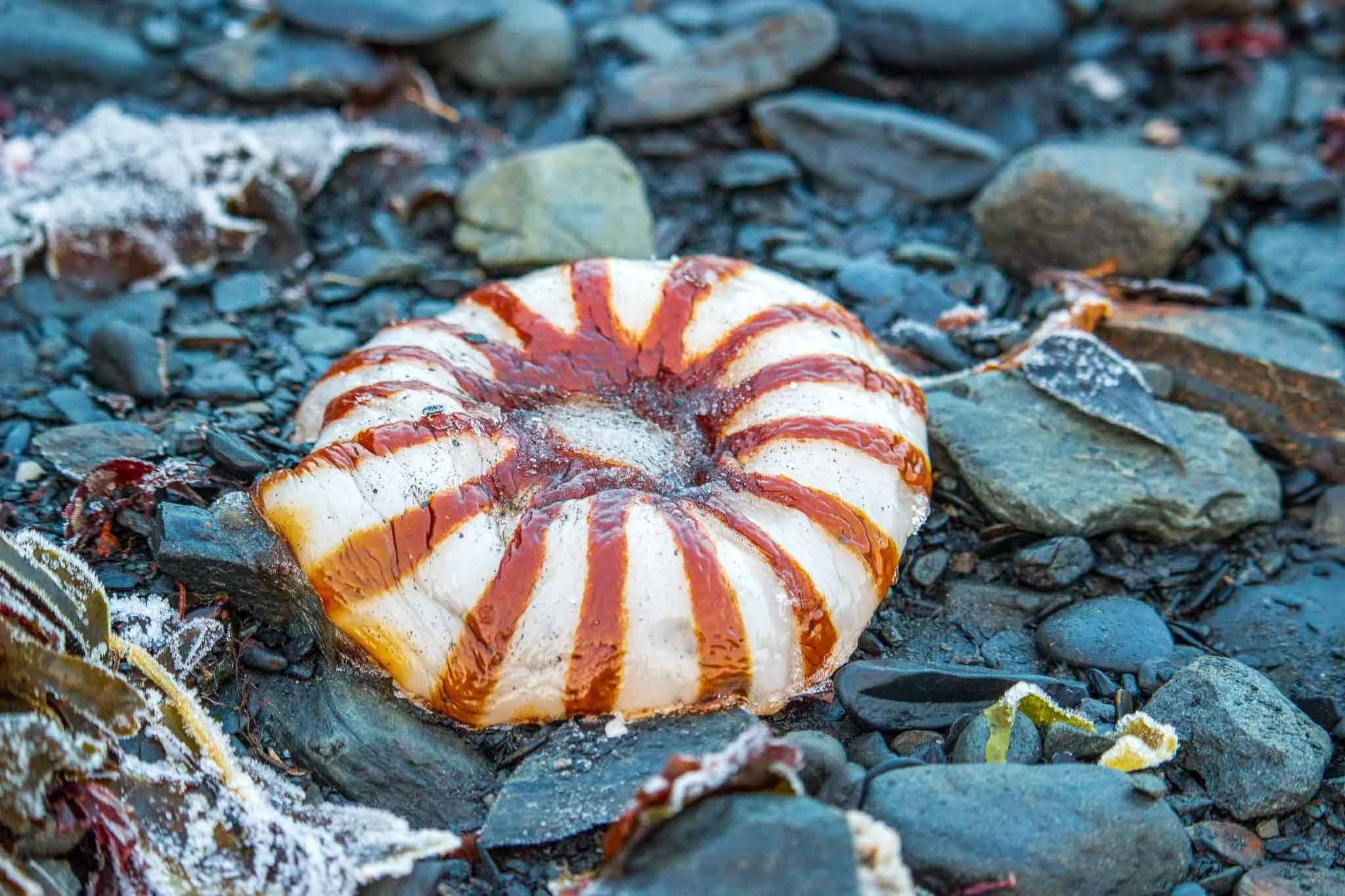
As we explored the shoreline, we found a northern sea nettle (Chrysaora melanaster) that had washed up and was lying there frozen.
Eagle River Nature Center: Albert Loop (Chugach State Park)
Scan for map & details
📏
3.2 mi
5.1 km
Distance
⛰
344 ft
105 m
Elevation
🔄
Loop
Route
Imagine yourself hiking through snow crunching beneath your boots. The cold is crisp, but you're wrapped so well with your plush gloves, fluffy winter boots, and soft hat,that the cold is blocked by the cozy layers. You walk down to a river; it lies so still, half frozen. Just a few weeks earlier, bears were fishing here in the rushing water, feeding themselves for their winter slumber, catching fresh salmon. Suddenly, you see shadows falling onto the pure white ground; they're moving. You look up and a pair of bald eagles is passing overhead. You start to hear David Attenborough's voice in your head, narrating your journey through a place that feels so wild and pure that it almost feels unreal. As you continue walking along the river, you start to notice places where nature created its own art inspired by the cold. The river is not just half-frozen; in places there is what looks like small explosions of ice, shaped into what appears like spiky flower heads. As you turn around and look further up the river, you spot a small, yet chunky bird on the ice, right at the edge of the water. It looks like it dressed up in a wetsuit, so dense are its feathers. A second later, the chunky fellow dips into the ice cold wet, disappears and emerges just a moment later. The dive was worth it: it comes back with a meal; a fish larger than its head, still swinging its tail back and forth. Sadly for the fish, the bird, an American Dipper is hungry and refuses to let go. You stand there, just observing it repeating its performance. You could have stood there for hours, but at some point you continue. Something that seems out of place catches your eye: glowing red berries hang on some twigs, surrounded by a sea of white. You take a closer look; some of the last red currants are still hanging on this late in November, almost December. With the white backdrop, they glow like a red light bulb.
Doesn't that sound like being in a fairytale? What you just imagined, wasn't a product of pure imagination, but exactly our experience. Hiking the Albert Loop was one of my favorite activities in Alaska, and everyone in my group agreed.
🪶 Wildlife Spotlight: American Dipper (Cinclus mexicanus)
🐧 Built for water. North America's only aquatic songbird, the American Dipper lives year-round on fast, cold streams — never migrating, no matter how harsh the winter. Waterproof feathers, white-feathered eyelids, a nasal flap that seals underwater, and oxygen-rich blood make it perfectly equipped.
🤿 The bob and the dive. The bobbing motion on a midstream rock is what gave dippers their name — most likely a way to communicate over the roar of rushing water. The dive is equally iconic: straight into the current, walking the streambed for up to 15 seconds, hunting larvae or small fish.
💧 A living water-quality report. Dippers vanish from polluted streams, making them a reliable indicator of clean water. Winter is the best time to spot one — fewer birds, no leaves, and their chunky silhouette unmistakable on the rocks.
Important Note
For much of the summer and early fall, the Albert Loop Trail is closed due to the salmon run and high bear activity. By November, the trails have reopened, covered in snow, with the river beginning to freeze, while the bears are slumbering instead of hunting for fish.
When we visited (at the very end of November), the trail was doable with just winter boots. Snow was compacted, but not slippery. Every winter is different — I recommend checking conditions before heading out, so you know if snowshoes or microspikes may be helpful.
There is a visitor center, where you can also get information about the hikes and the nature of the park. Plus, warming up there afterwards instead of getting into the cold car is a treat.
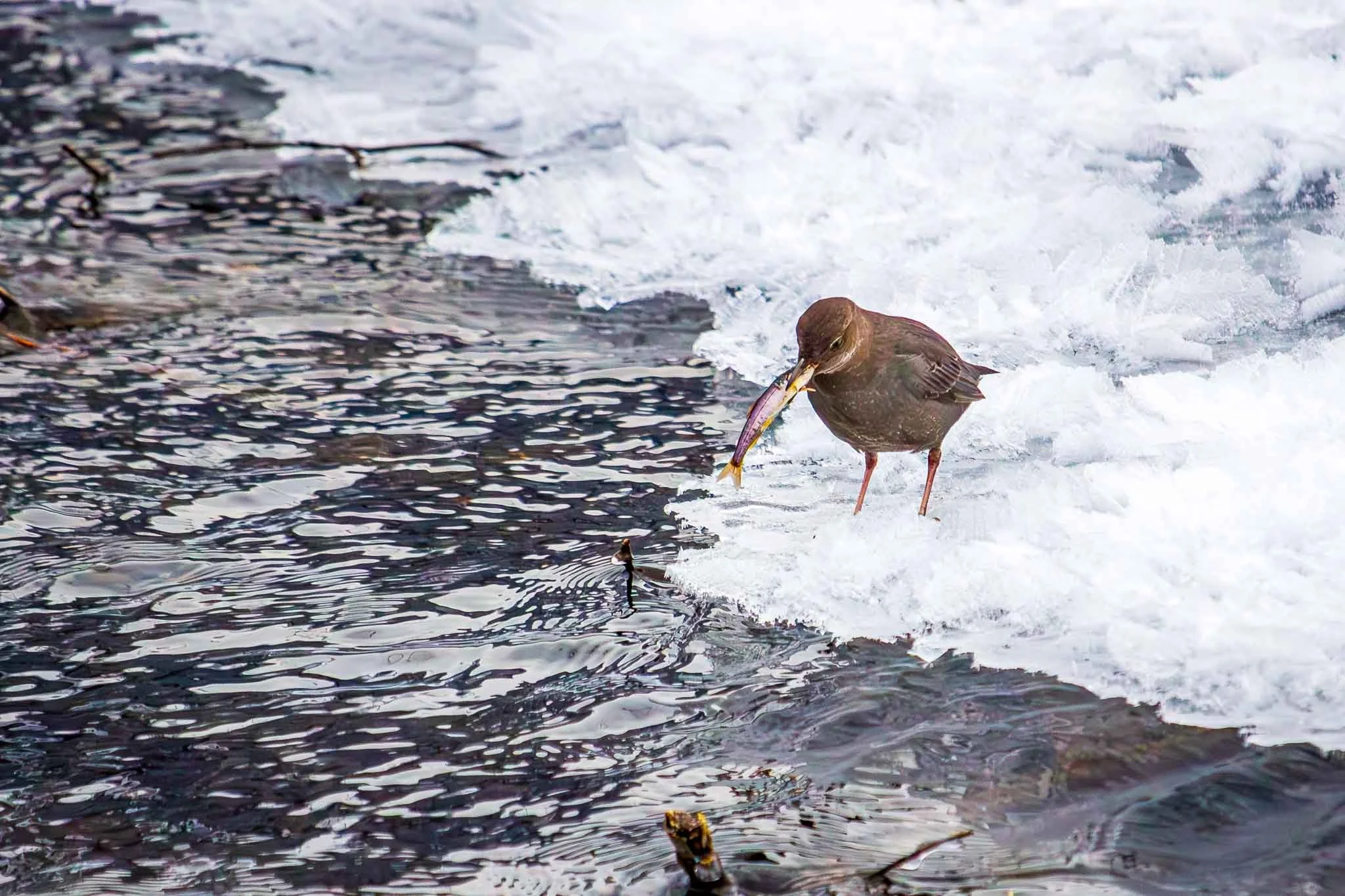
The American Dipper had success in catching a meal in the ice-cold river.


Musk Ox Farm (Palmer)
Muskoxen once roamed the northern regions of Alaska but were hunted to local extinction by the late 1800s. Thanks to reintroduction efforts beginning in 1930, when 34 animals were brought from Greenland, their numbers have rebounded to around 4,500 muskoxen now living in remote tundra areas of western and northern Alaska. Because of this, you won't encounter them around Anchorage in the wild.
The Musk Ox Farm in Palmer (about 45 minutes from Anchorage) is a nonprofit organization dedicated to the conservation, education, and husbandry of these impressive animals. Guided tours last about 45 minutes, during which you'll learn about their history, biology, and cultural significance.
The farm also combs the muskoxen for their fine underwool, called qiviut (pronounced kiv-ee-ute), which is then spun into yarn. In their gift shop, you can purchase pure qiviut products, renowned for being one of the softest and warmest natural fibers in the world. It really feels amazing. However, because qiviut is rare and valuable, it is not exactly cheap, so they also offer more affordable blends with other natural fibers.
💡 Did You Know?
🐑 Sheep, not cattle. While muskoxen look both massive and small at the same time, their closest relatives are actually sheep and goats — not cattle or bison. To me, this becomes especially clear when I look into their eyes, which have the gentle expression of a giant, woolly sheep.
Tickets
Best to book your visit directly through their website.
Northern Lights
It is possible to see the Northern Lights in Anchorage if the conditions are just right. The best chances to see the auroras are typically between 9 p.m. and 3 a.m., according to the Geophysical Institute of the University of Alaska. They also provide an Aurora Forecast, which you can check here. Get away from city lights and other bright lights to observe them better.
Note
However, if seeing the Northern Lights is a priority for you, I'd recommend heading farther north. Your chances are much higher in Fairbanks or near Denali National Park, as Fairbanks sits directly beneath the Auroral Oval and Denali is not far from it. If you'd like to learn more, check out my Fairbanks guide or my Alaska guide covering Anchorage, Denali, and Fairbanks for the full picture.
A heads-up: Pictures of the Northern Lights are typically taken with longer exposure times (for example, the first picture below was exposed for 25 seconds). This allows the camera to gather more light than the human eye can perceive. As a result, the images often appear more vivid than what you actually see. If the aurora activity is strong, you will absolutely see the lights dancing above your head, and it is truly magical — just don't expect them to be as colorful as the photographs typically show.
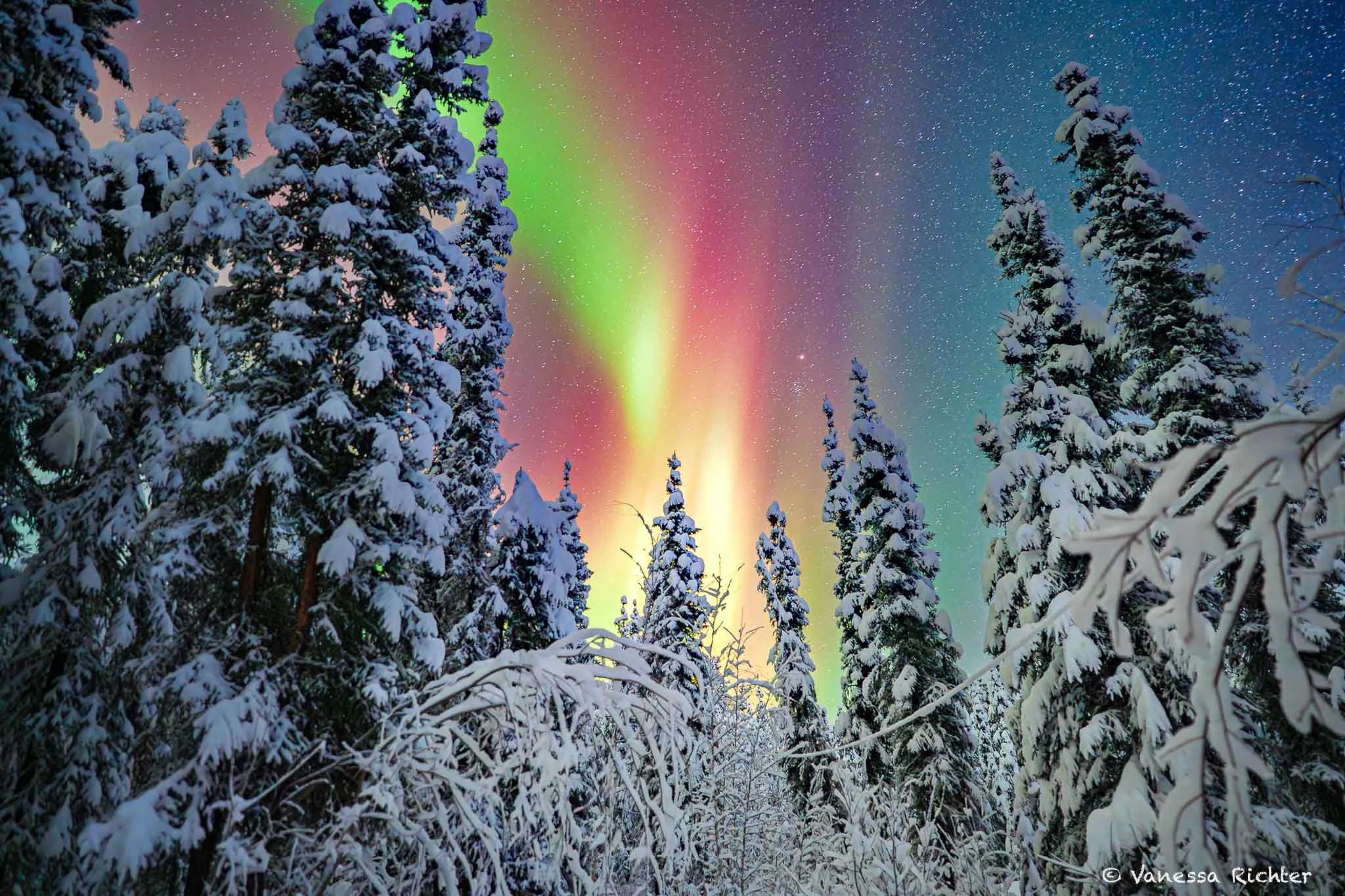
Green, red, and purple aurora borealis lighting up snow-covered trees.
Where To Stay
If you want to be within walking distance of the highest density of restaurants, cafés, and bakeries, downtown Anchorage is the place to be. That said, if you rent a car — which I recommend if you're comfortable driving in icy conditions — parking downtown is easy to find. We opted for a vacation rental south of downtown, close to the bay, which gave us the feeling of being close to nature while having the conveniences of being in the city as well.
South Anchorage · Alaska · Close To Nature · Modern
Bootlegger's Nest
We stayed in a vacation rental close to the bay and loved it. From our bedroom, we could see the glittering, half-frozen water, and one morning, moose wandered right through the neighborhood, which we obsserved through the large window in the living area. The house itself was ideal for two couples or a family: two en-suite bedrooms upstairs, plus a spacious open kitchen and living room with another half bath downstairs.
book
Looking for a different vibe? Check more available accommodations here:
Know Before You Go
Be Prepared For Freezing Temperatures
Since Anchorage is located at the coast, the climate is more moderate than inland areas like Fairbanks or Denali, but it is still cold. Average winter temperatures in December are around 18.8°F (-7.3°C).Gear & How to Dress
Functional Layers: Base layers, wool or fleece sweaters, and thick insulated jackets will keep you warm. Layer your gloves (thin gloves + thick mittens) and consider hand warmers.
Footwear: Invest in winter boots made for extreme cold and get wool socks that keep your feet warm. Feet (and hands) will get cold first. I have a pair from Bogs rated for temperatures down to -58°F and my husband has the very popular Caribou winter boot model from Sorel. Both kept feet warm and dry in the snow and down to -35 degrees (don't worry if you're just visiting the Anchorage area — it probably won't be that cold). What I loved about mine beyond that was that they have a pull tab which you can use like a handle when you put them on, so despite being a winter boot, I could just slip them on without the hassle of tying them every time.
Head: A warm hat and a neck gaiter (more effective than a regular scarf in my view!) are essential. That's the one we used. Consider getting a balaclava too if you're heading further north or if you are very sensitive to cold.
Handwarmers: Rechargeable hand warmers helped me SO much in keeping my hands toasty. I have notoriously cold hands, so I knew just wearing gloves will not do the trick if I am outside for longer. So, I put battery-powered handwarmers in my mittens and I never had cold hands despite frigid temperatures. Here are the ones that worked perfectly for me.
Microspikes: Absolutely essential for icy paths. Easy to put on over boots and provide excellent traction on packed snow or ice. They don't need to be expensive to work well. Here are the inexpensive ones we've been using for years.
Snowshoes: Crucial for deep snow or unbroken trails. When we visited, we didn't need them around Anchorage — there hadn't been recent snowfall and what was on the ground wasn't particularly deep. Whether you'll need them depends on how far into winter you go and the snowfall at the time, but since Anchorage is a city you can always pick up a pair there if needed. The farther north you head, the higher the chances you'll want them — we used ours on the trails around Denali and near our Fairbanks vacation rental. The snowshoes we use and recommend come in a men's version and a women's version — easy to strap on (a bigger deal than it sounds, especially in the cold), lightweight, and functional on both flat and elevated terrain.
Be Prepared For Limited Daylight
Short Days, But Long Twilight: Winter days are short, but dusk and dawn last long due to Alaska's northern latitude. After sunset, civil and nautical twilight provide extended light. Don't be discouraged by early sunsets.
All-Day Glow: The low sun creates soft, golden light, which is great for photography and just enjoying an all-day long magical atmosphere. Winter is also prime aurora season. You need more luck in Anchorage than places further north like Fairbanks, but if the activity is strong, auroras are definitely possible. Check the University of Alaska Fairbanks aurora forecast to plan your best viewing nights.
Plan Ahead: Check sunrise, sunset, and twilight times for your location and time of visit, and plan accordingly.
Road Conditions, Driving Tips & Car Rental
Slippery Roads: Roads can be extremely slippery in winter, and sudden movements can make you lose control very quickly. We witnessed several cars in ditches and one instance where another vehicle slid across our lane into deep snow. Expect black ice and compacted snow, even in cities and on major highways. Drive slowly and avoid sudden braking or steering.
Stay Focused: Because roads are often slippery, it is crucial to stay 100% focused to drive as smoothly as possible and anticipate upcoming hazards. Check Alaska DOT for current road and weather conditions before you head out.
Don't Follow Local Speeds: Locals often have studded tires; most rental cars do not. Let them pass.
Rental Cars: I recommend all-wheel drive to make driving in snowy conditions safer. Check below to compare the best available rates:
Follow the Adventure
Latest on the Blog
Search

I’m the writer and photographer behind Venture Beyond the Picture.
You're in the right place if you're looking for nature-focused guides, real tales from the trails, and photography that celebrates wild landscapes. I'm especially drawn to the quieter, equally fascinating details in nature that are easy to miss, and to digging into the ecological story of a place. You'll find a range of easy-to-scan travel guides, deep dives, stories from my favorite hiking trails, and the occasional science-y exploration of the latest research on ecological topics.