
The Drama of Northern California’s Kelp Forests in Five Acts: How It Unraveled, And Why Freshwater May Save the Last Kelp Patches
A decade ago, Northern California lost most of its kelp forests, but the drama had started long before. Now, new research is revealing what is holding the line for the last patches (for now), and whether a long-lost predator is making a comeback.
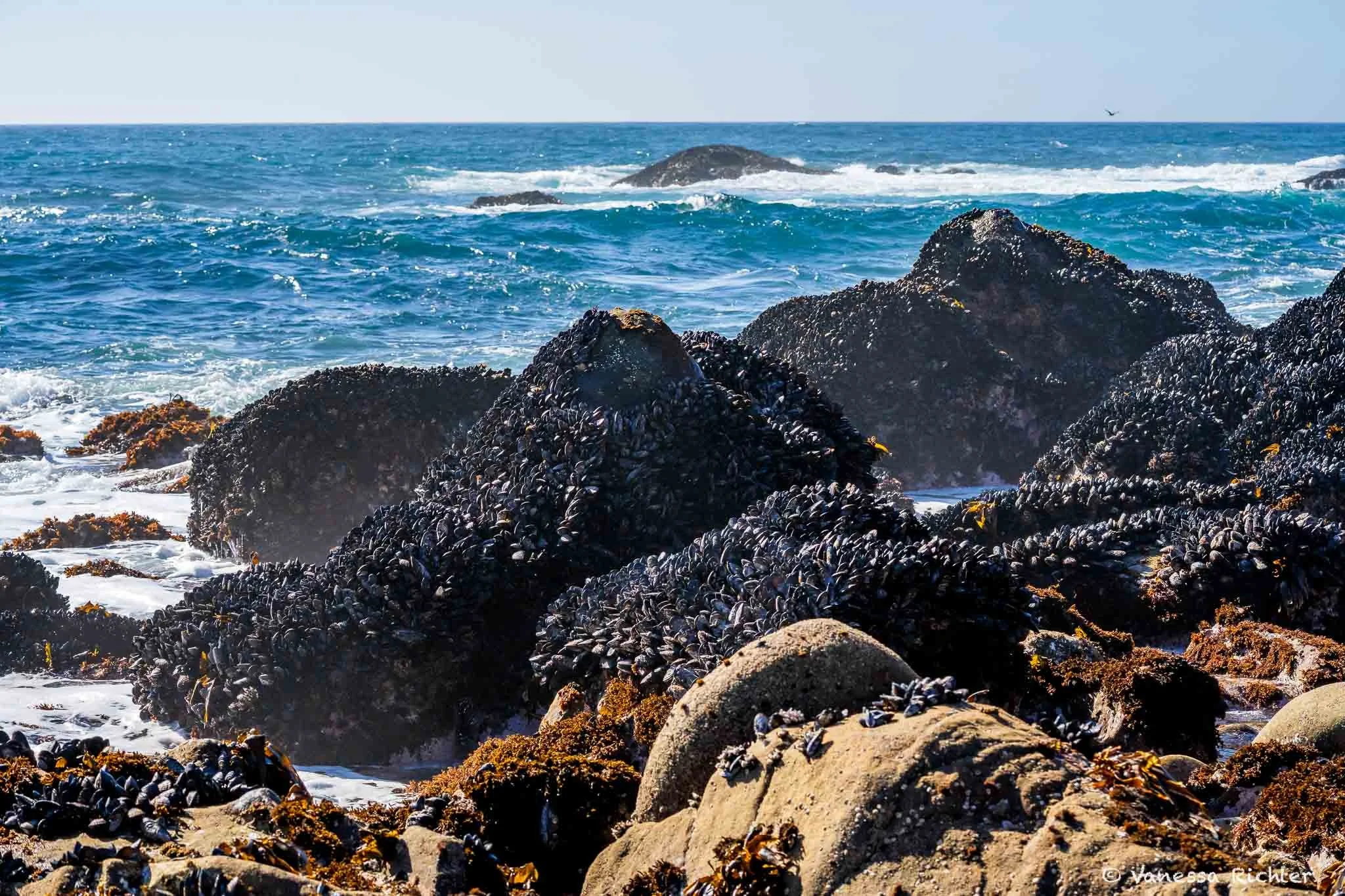
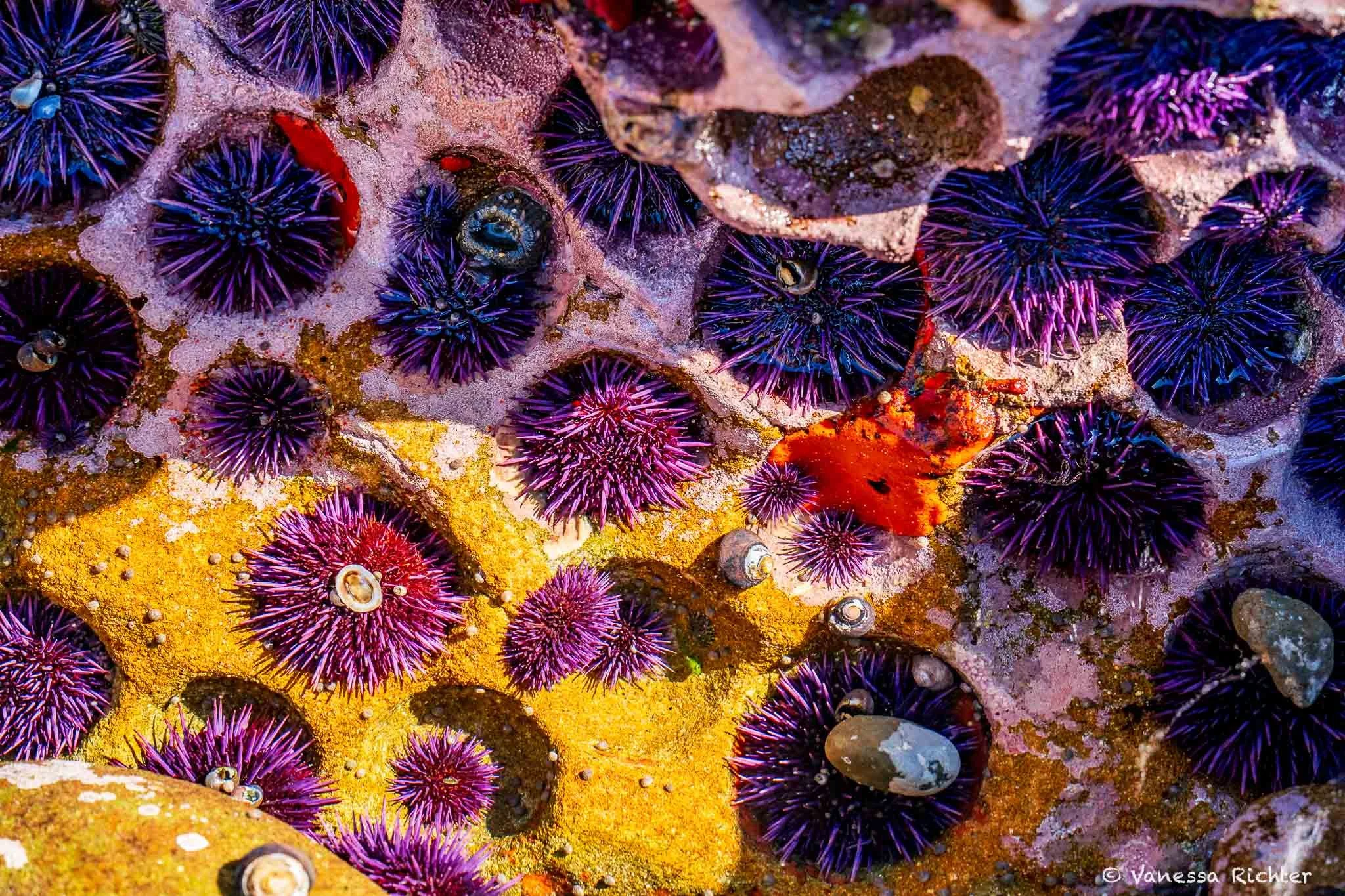
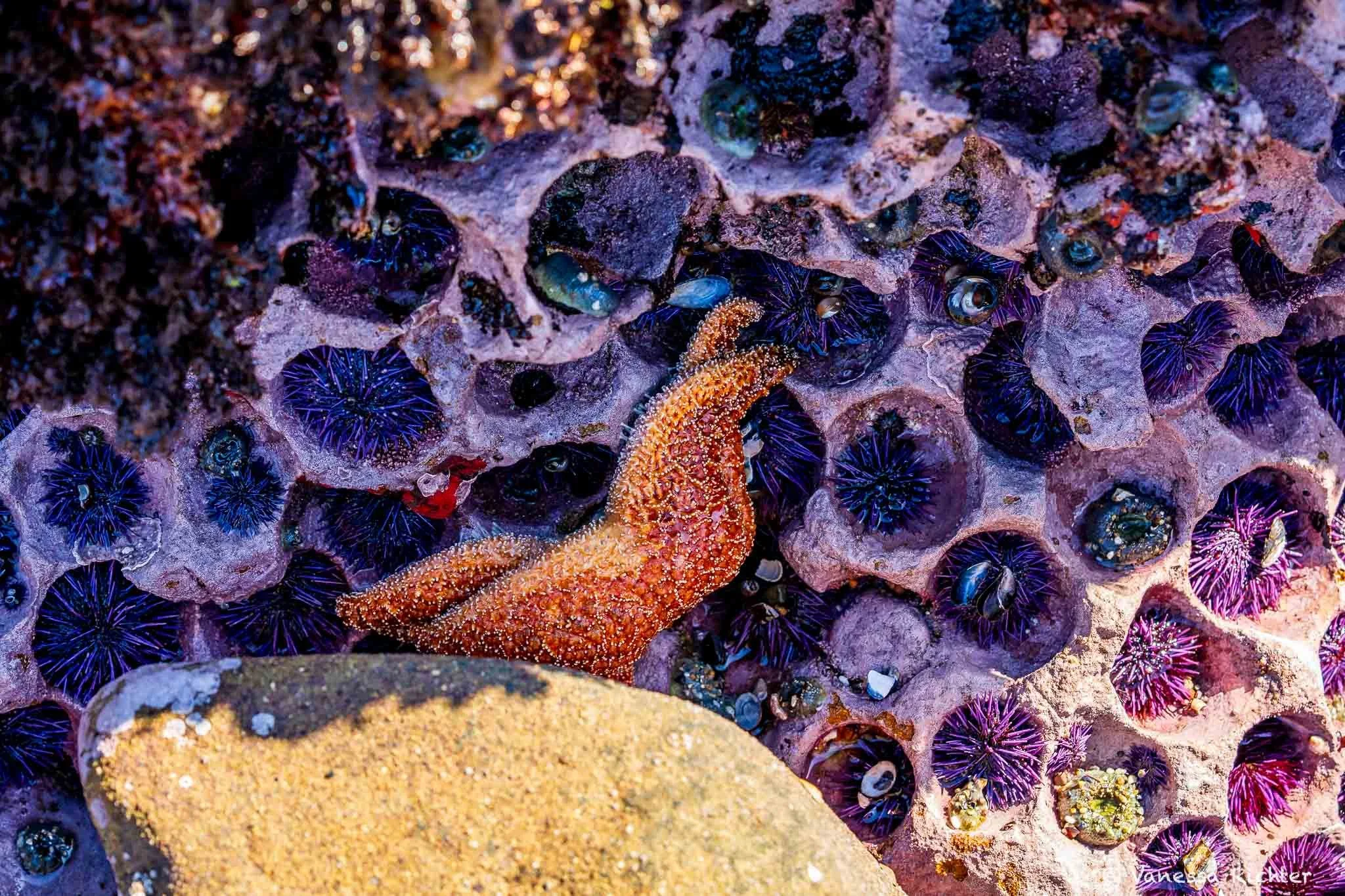
When you first gaze over the colorfulness of the tide pools at Salt Point State Park, a rugged, remote stretch of the Northern California coast, you automatically have the impulse to call it beautiful, and because it appears that way, it is similarly tempting to think that this must be a healthy ecosystem. Purple spines seem to be neatly packed into every single bowl-shaped hollow in the sandstone. It almost looks like someone decorated the coast. Yet, all the visual pleasure is in fact masking a severely suffering ecosystem. The purple balls are sea urchins and they're sitting so neatly packed in these holes because they have nowhere to go. The kelp that they feed on, the foundation of California's underwater forests, is long grazed away.
The sad irony is that with key predators gone, they were doing so well for a while that their large populations ravaged the kelp until there was nothing left to eat. Now, they are sitting in these holes slowly starving as they can go without food for a long time. What looks so cheerful is actually a silent drama, and the tragedy started far before the starving sea urchins.
In This Article
Prologue: Why Kelp Matters
Most people know how important terrestrial forests are for our existence on Earth. They sequester carbon, provide shelter and food for a variety of species. They even have scientifically measurable positive effects on our mood. It is easy for us to see their impact and appreciate their value. Underwater forests are less visible, yet equally important for marine ecosystems, and down the line, our terrestrial existence.
In Northern California, large parts of the coast were historically covered in bull kelp forests. The kelp does not have roots like a tree, but instead anchors itself onto rocks with what is called a holdfast. Being the primary structuring component in these rocky reefs, they are important for many reasons: they positively affect the water flow and nutrient dynamics, modify light levels and sedimentation, sequester carbon, and produce oxygen. By creating habitat structure, dense kelp beds are in fact biodiversity hotspots, as they create distinct ecological niches in which they provide shelter and nursery habitat for marine species. Because of that, they are also economically important. Without kelp, some commercially relevant species like rockfish could not thrive. What's more, they absorb and dampen wave energy, and as a result, they protect the coast from storm damage and erosion.
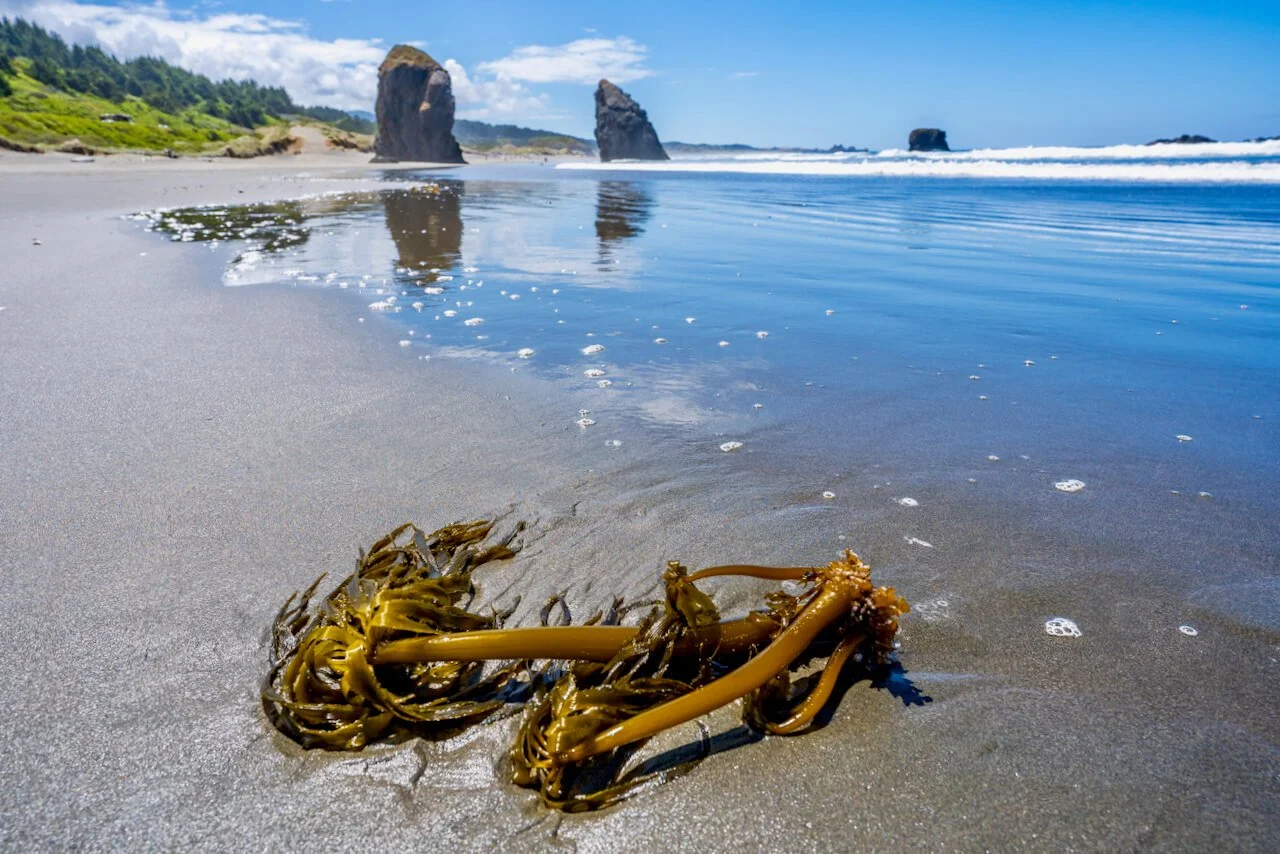
Act I: How The Fur Trade Extirpated Sea Otters In Northern California
The tipping point for the kelp forests came just a decade ago. But actually, this drama has planted its roots much earlier. As I combed the California Digital Newspaper Collection for ‘sea otters’ to learn what the media reported on them over the years, one of the first mentions popped up in the year 1848. At first, I was puzzled to see them all marked in big letters reading advertisement, but my confusion would soon become clear when I discovered that those hits were not random co-mentions. Actually, sea otters, or to be more specific, their fur, was exactly what was advertised at the time. Even knowing that they were hunted at the time, seeing fur ads alongside bread, cheese, and cigars, just like any other product, made me step back into the past more than I would have liked. Of course, the sea otter was not alone in the FURS category, land otter and beaver pelts were advertised as well, but the premium price made it clear that the sea otter was the most rare and sought after:
From the "Wholesale Prices Current," California Star, April 22, 1848
Furs — Sea otter, prime: $35.00 ($1,532.59 today) · Land otter: $1.50 to $2.00 ($65.68 to $87.58 today) · Beaver, per lb.: $2.00 ($87.58 today) [Source: MeasuringWorth]
Even though that first newspaper hit dated back to 1848, the fur trade itself started more than a century earlier, reportedly in 1741, and did not end until 1911, when otters received legal protection from hunting under the International Fur Seal Treaty. Prior to European settlement, they were widespread and abundant, living along the North Pacific coast from the islands of northern Japan and Alaska to central Baja California in Mexico. The fur trade led to extirpation (local extinction) in many parts of the coast long before they received legal protection, including the Sonoma coast around Salt Point State Park. While sea otters were highly valued in fashion for their pelts and skins at the time, their disappearance made clear how invaluable they are for coastal ecosystems. Among their diet: sea urchins, which they eat in large numbers, plucking them off one by one. Their feast on the spiky urchins is doing an important ecosystem service for free: controlling their numbers, so urchin populations don’t get so large that they graze down entire kelp forests. In doing so, they provide a service so extraordinarily foundational for the health of the ecosystem that they are considered a keystone species.
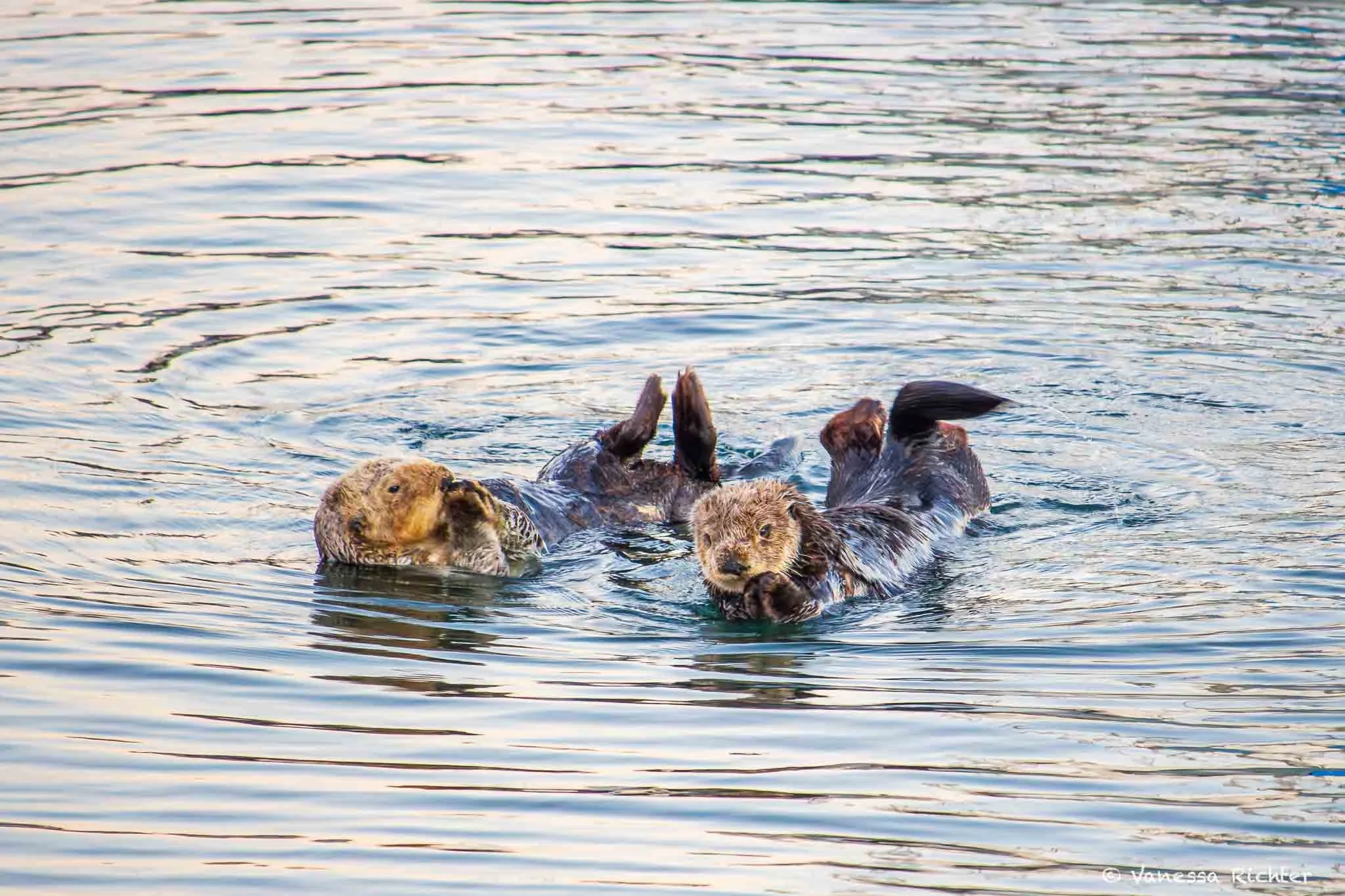
I took this photo in Morro Bay, one of the few places where you can still find sea otters like these two playful cuties that were feasting on mussels and rolling around more times than I can count.
Act II: Marine Heat Waves & Sea Star Wasting Disease
Even with the sea otters extirpated, the bull kelp forests along the Northern California coast were still flourishing because another keystone species held the line for the ecosystem: sunflower sea stars. Like otters, they prey on sea urchins, keeping their population sizes in balance with the ecosystem. In the summer of 2013, everything changed. A disease, which would stay a mystery for over a decade, started devastating sea star populations along the west coast of North America, all the way from Alaska to Baja California. Sunflower sea stars were particularly impacted, rapidly vanishing from the Northern California coast. Within just a single year, they became functionally extinct. A few years later, between 2016-2019, not a single sunflower sea star was observed on this stretch of coast anymore, suggesting their local extinction.
Coinciding shortly after the start of the sea star wasting disease (SSWD) was the occurrence of a marine heat wave, dubbed The Blob, originating in the Bering Sea and Gulf of Alaska in 2013 and reaching California in 2014. With sea surface temperatures 2.5 degrees Celsius warmer than normal for 226 days, it led to mass die-offs in offshore birds and mammals. Studies suggest that the abnormally warm ocean temperatures did not set off the disease outbreak for the sea stars though. But once SSWD took hold, scientists suspect the warming water made it deadlier. For the kelp itself, the warmer temperatures translated into thermal stress and less nutrient availability.
Act III: From Kelp Forest To Sea Urchin Barrens
It is hard to believe when you gaze over the tide pools in Northern California now. Yet, before sea star wasting disease and the marine heat wave hit in 2013, sea urchins had actually been scarce in the subtidal zone. Then everything changed in a flash. By 2015, with sunflower sea stars, their last major predator, functionally wiped out, urchin populations exploded.
With a 60-fold increase in sea urchins and food becoming increasingly limited, they ravaged the kelp and fleshy algae relentlessly, and subsequently through the pink coralline crust cover. At the same time, kelp growth and spore production were suppressed by the marine heat wave, speeding up the downward spiral for the ecosystem.
These adverse, global-warming-driven ocean conditions persisted for multiple years, while sea urchin populations increased until they had nothing left to eat. Now, being able to live without food for years, and slowly starving with the kelp forests gone, they sit and wait in those bowl-shaped hollows.
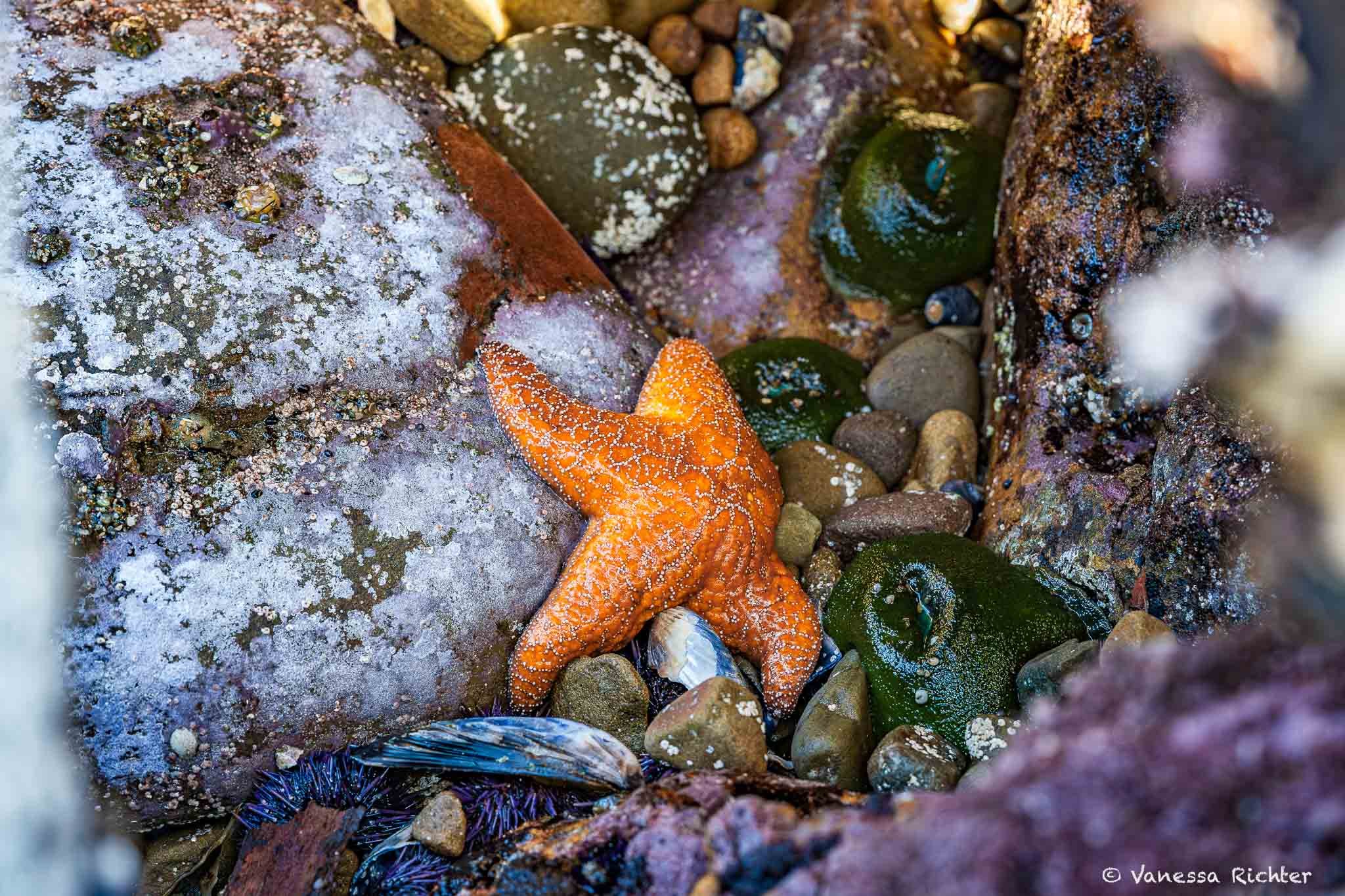
Ochre sea stars, like the one in the photo, do eat purple sea urchins, but prefer species with more flesh, like mussels. Like sunflower sea stars, they were hit by SSWD, but recovered quickly in the northern part of their range.
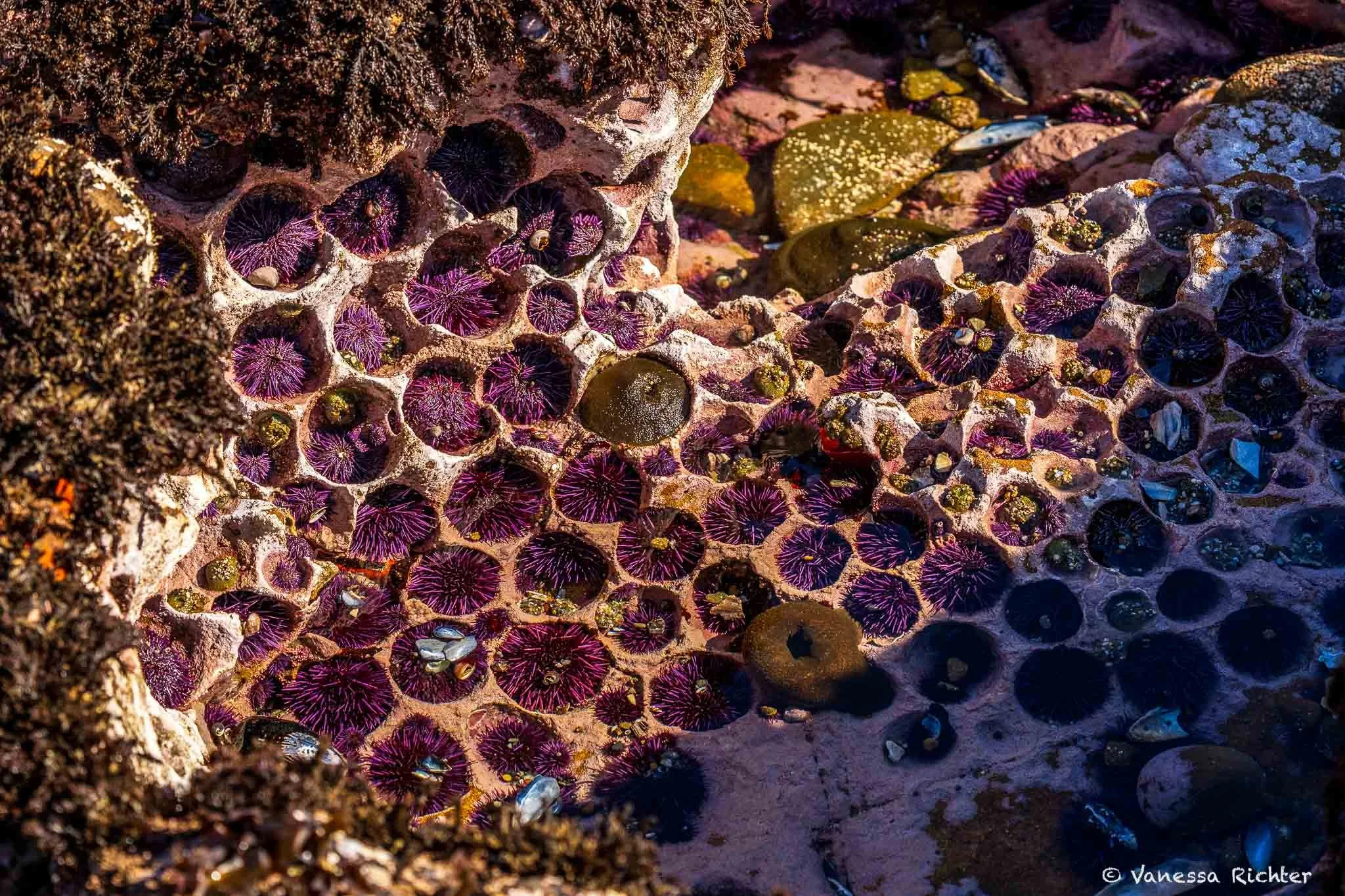
Sea urchin barren at salt point state park — purple sea urchins and mussels dominate in many places along the Northern California coast after keystone species like sea stars and otter populations got diminished massively.
Act IV: How Freshwater Is Holding The Line For The Last Kelp Patches
When most of the Northern California coast went from biodiversity-supporting kelp forests to functionally dead sea urchin barrens in an astonishingly short time, there were, and still are, places in which the kelp held on.
Aurora Ricart and colleagues investigated why these remnant patches have been resistant when 90% of kelp forests disappeared. Between 2020 and 2022, they surveyed several sites along the coast to figure out where the remaining patches are and what makes them more resilient.
It may seem counterintuitive to search for the answers on land. Yet, that is exactly what their research suggests taking a closer look at: the patches where kelp persists are where land meets the sea, or to be more specific, where rivers and streams pour freshwater into the salty ocean. The more freshwater, the more abundant the kelp. While there is no scientific study suggesting that freshwater allows bull kelp to ‘disperse or grow better’, the most direct explanation had to be found not in the kelp itself.
Even though sea urchins had ravaged the kelp at lightning speed and were now running out of food in most places, their population density in the kelp patches that held on was lower than in the areas where they had nothing left to eat. To learn more about the connection between the purple sea urchins and freshwater, the researchers went to Arena Cove, where they collected sea urchins, and took them to a laboratory. While letting the urchins acclimatize in flowing seawater tanks, they simultaneously put them on a fasting cure. Three days later, they were relocated into different aquaria, the only difference: how salty the water was. Once in their new temporary home, they were offered a meal again: bull kelp, of course, to see how voraciously they would work through the fleshy green. The results were revealing: the lower the salinity, the less they grazed on the kelp, providing an explanation for why those kelp patches near freshwater remain. Streams and rivers pouring freshwater into the ocean provide the service that usually the sunflower sea star or sea otter would take care of: keeping the sea urchins in check; at the very least by decreasing the grazing pressure locally.
This wasn’t all, however. They also discovered that kelp populations were more intact where there was more sand between the rocky sections — even though kelp needs rocks to anchor. But the purple sea urchins cannot thrive without the rocks either. With their sharp teeth and spiny bodies, they grind on and carve into the stone, creating these hollows that allow them to protect themselves against waves and predators. In the sand, they are more exposed and it makes traveling harder for them.
Even with these hopeful findings that may buy more time for the kelp forests to recover, the question remains whether these last kelp patches will stay preserved by the inflow of freshwater and sandy bottoms, or if they are just on a longer way to sea urchin barrens in the end, and if so: how much time is left? And even if they persist: will these last patches stay remnants of a marine ecosystem that once was, or be the starting point for recovery?
Even in the areas with larger kelp density and higher biodiversity, one finding was clear: the purple sea urchins were far more abundant than they’ve ever been in recorded history.
Act V: Can the Urchins' Reign End?
After being absent for more than a decade, leaving little hope for the sunflower sea star’s recovery, they have recently been spotted again along the Sonoma coast.
In June of 2025, scientists from Sonoma State University’s Dr. Brent Hughes ecology and conservation lab discovered an adult sunflower sea star at a regular diving spot that they monitored for kelp recovery research. When Rachael Karm, a research technician with the lab, came back about a week later, she found four more individuals, all juveniles, which meant that the stars must have successfully reproduced. The discovery prompted her to organize a diving blitz, which they dubbed Pycnopalooza, and two months later, a team of 25 scientific divers came together at a cove off the coast of Sea Ranch. They searched two days for the elusive critter, and found 18 individuals of which they collected genetic samples, more specifically environmental DNA (eDNA).
It is the largest and southernmost population to be sighted again along the Pacific coast after the devastating sea star wasting disease (SSWD) wiped out a mind-boggling 99% of the species.
What’s more, the disease-causing agent of SSWD was a mystery for about as long, but recently research by Prentice and colleagues, published in August 2025, identified a strain of the bacterium Vibrio pectenicida, FHCF-3, as the causative agent of the disease.
The identification of the driving pathogen and eDNA samples of a potentially disease-resilient population will allow researchers to better understand the drivers of the disease, and may enable the breeding of disease resilient sunflower sea stars down the road.
After all, maybe freshwater can hold the line for the kelp until sunflower sea stars bounce back and stop the voracious urchins from grazing the forest bare: for the good of the ecosystem including the starving urchins.